p53 and mTOR: Distributed Intelligences in the Cell

At first glance, p53 and mTOR appear to represent two very different strategies for regulating cellular behavior. p53 is traditionally viewed as the guardian of the genome, responding to DNA damage by determining whether a cell should pause, repair itself, enter senescence, or die. mTOR is regarded as the master regulator of growth, integrating nutrient availability, energy status, growth factors, oxygen, and mechanical signals to determine whether the cell should build new proteins, synthesize lipids, divide, or conserve resources. Yet modern cell biology reveals a remarkable similarity beneath these different functions. Neither protein functions as a single molecular switch. Instead, both operate as distributed populations of interacting molecules whose collective behavior produces decisions far more sophisticated than any individual molecule could achieve.
A mammalian cell typically contains on the order of 50,000 to 200,000 mTOR molecules, assembled into tens of thousands of mTORC1 and mTORC2 complexes scattered throughout the cytoplasm. Similarly, most mammalian cells contain approximately 20,000 to well over 100,000 p53 molecules, depending upon cell type and the degree of stress. During severe DNA damage, repeated waves of stabilization can greatly increase the p53 population. Neither system depends upon a single master molecule. Instead, both rely on enormous molecular societies whose members continuously communicate through chemistry, molecular shape, and time.

The distributed intelligence of mTOR is primarily spatial. Thousands of mTOR complexes occupy distinct physical locations throughout the cell. Large populations assemble on lysosomal membranes, where they measure nutrients generated by lysosomal digestion. Other complexes occupy focal adhesions at the plasma membrane, sensing mechanical forces and growth-factor signaling. Additional populations function near the Golgi apparatus, endosomes, stress granules, ribosomes, the nuclear envelope, peroxisomes, and mitochondria-associated membranes. Each location provides access to a different subset of information. One lysosome may contain abundant amino acids while another remains relatively depleted. One region of the plasma membrane may experience strong mechanical tension while another does not. Rather than performing a single centralized measurement, the cell conducts thousands of simultaneous local measurements. Each mTOR complex contributes its own local assessment, and the integrated behavior of the entire population determines the overall growth state of the cell.
p53 is distributed differently. Its intelligence is concentrated primarily within the nucleus and unfolds across space, time, and chromatin rather than across cytoplasmic organelles. Thousands of p53 molecules continually diffuse throughout the nucleus, binding and releasing DNA every few seconds while scanning millions of DNA sequences before locating one of the hundreds of authentic p53 response elements. A response element is a short, specific DNA motif (a binding site) insidea larger sequence called the promoter (or within a different sequence called the enhancer). Specific regulatory transcription factors bind to these response elements when activated by a stimulus (like a hormone, heat shock, or growth factor) to turn the gene on or off. A promoter is the entire control panel for starting a gene, and the response element is a specific switch on that panel designed for a particular signal.
At any moment, different p53 molecules occupy different promoters, different chromatin environments, and different molecular partnerships. The decision made by the cell therefore does not arise from one p53 molecule reading the genome, but from tens of thousands of independent DNA-binding events occurring simultaneously throughout the nucleus.

The remarkable feature of p53 is that these thousands of molecules are not chemically identical. See the previous post on p53, which shows how p53 is a vast regulatory and signaling platform with a large amount of variables that are defined by the specific molecular tags present, the shape these tags produce, and the time sequence of the life of that particular version of p53. At any instant, one p53 molecule may carry phosphorylation at serine 15 from kinase ATM signaling, another may be phosphorylated at serine 20 by CHK2 kinase, another acetylated by p300/CBP enzyme, another methylated, another SUMOylated, another ubiquitinated by MDM2 and destined for degradation, while still others remain relatively unmodified. Some molecules interact with MDM2, others bind transcriptional coactivators, others associate with chromatin remodelers, and still others occupy DNA response elements. The cell does not contain one biochemical form of p53 repeated thousands of times. Instead, it contains a continuously changing statistical distribution of many chemically distinct populations that act together.
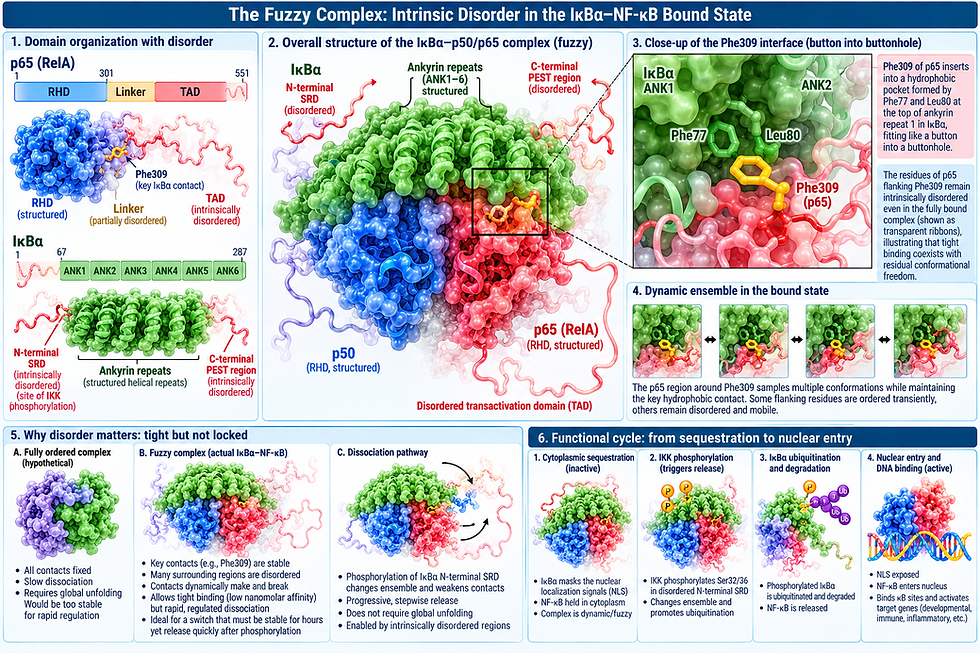
The chemical differences produce structural differences. Because the N-terminal and C-terminal regulatory regions of p53 are intrinsically disordered, each pattern of phosphorylation, acetylation, methylation, ubiquitination, and SUMOylation shifts the ensemble of shapes that the molecule can occupy. These altered shape ensembles expose or conceal binding surfaces, changing which cofactors can bind, how long DNA interactions persist, and which genes become activated. The physical state of the entire p53 population therefore continuously evolves as signaling pathways modify individual molecules.
The consequences become apparent at individual promoters on the DNA. For example, the p21 promoter does not encounter "the p53 molecule." Instead, it encounters a particular statistical population of p53 variants carrying specific combinations of modifications, arriving with particular residence times during a specific phase of a signaling pulse within a unique chromatin environment. Each promoter encounters a different population because its chromatin accessibility, binding affinity, cooperating transcription factors, and local nuclear environment differ. Every promoter effectively samples its own local population of p53 molecules. Gene regulation therefore emerges from population statistics rather than from the behavior of a single molecule.

Time adds yet another layer of distributed computation. Unlike mTOR whose signaling often reflects relatively continuous changes in nutrient availability, p53 frequently communicates through oscillations. DNA damage activates two important kinases, ATM and CHK2, stabilizing p53 by preventing MDM2-mediated destruction. As p53 accumulates, it activates transcription of MDM2 itself. Newly synthesized MDM2 eventually restores p53 degradation, completing a delayed negative-feedback loop that generates pulses separated by roughly five to six hours in many human cells. Each pulse represents a complete cycle of stabilization, transcription, degradation, and resetting.
Importantly, each oscillation creates an entirely new molecular society. During one pulse, tens of thousands of p53 molecules accumulate carrying one distribution of modifications. Hours later, many have been degraded, while newly synthesized molecules arise under different signaling conditions. The second pulse therefore consists not merely of another rise in concentration but of a new population possessing different phosphorylation states, different acetylation patterns, different chromatin environments, altered MDM2 levels, remodeled chromatin, different metabolic conditions, and a partially repaired genome. The cell is therefore not simply repeating a signal; it is computing with history.
This temporal behavior has a striking parallel with the spatial organization of mTOR. mTOR's intelligence emerges because thousands of complexes simultaneously monitor different parts of the cytoplasm. p53's intelligence emerges because thousands of molecules simultaneously monitor different parts of the genome while successive populations accumulate over time. mTOR distributes its information across space; p53 distributes its information across chromatin and time.

Both systems therefore illustrate an important principle of biological organization: broad cellular intelligence emerges throughout populations of intelligent molecular complexes. Countless individual molecular events—local nutrient measurements, transient DNA-binding events, post-translational modifications, shape changes, cooperative interactions, and feedback loops—are integrated into coherent cellular decisions. Each molecule contributes only a tiny fragment of the available information for cellular regulation. The remarkable behavior arises because thousands of such fragments are combined into a distributed computation. This is similar to the way a society of intelligent individual human beings produces the direction of a nation or society. It is the way the advances of science and culture operate.
This perspective changes how we understand the molecule’s increasing complexity. As mTOR accumulated additional regulatory proteins, new subcellular locations, new binding partners, and new feedback loops, its distributed network expanded. Likewise, as p53 acquired intrinsically disordered regulatory domains rich in phosphorylation, acetylation, ubiquitination, methylation, and SUMOylation sites, together with oscillatory feedback circuits, hundreds of promoter targets, chromatin interactions, and new connections to pathways such as AMPK and mTOR, its collective information-processing capacity grew enormously. Complexity grew by expanding the number of interacting molecules, the diversity of their chemical states, and the richness of their communication.
Modern structural and systems biology shows a new way of viewing the master molecular regulators. mTOR is best understood as a distributed cytoplasmic intelligence that continuously evaluates the cell's external and internal resources through thousands of local molecular assemblies. p53 is best understood as a distributed nuclear intelligence that continuously evaluates genome integrity, chromatin state, metabolism, oxidative stress, and temporal history through tens of thousands of dynamically changing molecules. In both systems, biological function emerges not from a single molecular machine but from the coordinated behavior of vast molecular populations whose collective interactions produce decisions of extraordinary sophistication.