Adenosine Intelligence Beneath the Ubiquitin Cellular Language

A Handle, Not Just a Fuel
Most people know adenosine triphosphate, ATP, as the cell’s fuel. Fewer know that the same adenosine unit sits inside many of the cell’s most vital molecules that carry electrons, methyl groups and acetyl groups, inside the letters of RNA and DNA, inside the signals that cells send one another, and inside the folded architecture of RNA itself. The repeated use of one small molecule for so many unrelated jobs is a clue to the deep history of life and the source of its intelligence. Ubiquitin is one of the cell’s most sophisticated information systems, a tagging language that decides which proteins live, die, move or switch on. How much of that system’s intelligence is really the molecule adenosine’s intelligence?
The short answer is quite a bit and in four distinct ways. Adenosine gives the ubiquitin system its grip, its ink, its direction and one of its sensors.
The Grip: Why Ubiquitin Needs an Adenosine to Be Picked Up
Ubiquitin ends in a short tail whose last chemical group will not react with other proteins by itself. It has to be made reactive first. The cell’s first ubiquitin enzyme, the E1, does this by using ATP to attach an adenosine mono phosphate, AMP, to the end of the (C-terminal) tail of the ubiquitin molecule. This ATP-driven step creates an activated intermediate called ubiquitin-AMP (or ubiquitin adenylate), preparing the ubiquitin to be transferred down the cellular tagging cascade
The AMP acts like a handle that makes the tail easy to grab. Once it is on, the E1 can swap the AMP for its own cysteine and pass the ubiquitin down the line to the next enzymes in the system, E2 and E3, that finish the job. Each ubiquitin loaded this way costs one ATP, split into AMP and pyrophosphate, so even a short four-ubiquitin chain costs at least four.

For clarity there is a difference between what a kinase (like AMPK and mTOR) does and what the enzyme E1 does. While a kinase transfers a single, tiny phosphate group to a protein, the E1 enzyme transfers a whole AMP molecule (which is a phosphate + a sugar + a base) to the ubiquitin tag. By adding a tiny phosphate group to a protein, the negative charge changes how the protein folds, instantly turning its function on or off.
The E1 enzyme acts like packing a spring. It forces a large AMP molecule onto ubiquitin. This creates a highly unstable, high-energy bond that wants to snap. That instability is what allows the E1 enzyme's sulfur atom to easily kick the AMP out and lock onto the ubiquitin. E1, the ubiquitin-activating enzyme, uses ATP to attach a ubiquitin molecule to itself via a high-energy thioester (sulfur) bond. Cells use sulfur instead of oxygen because sulfur creates a highly unstable, high-energy bond that acts like a loaded spring. This chemical instability is exactly what allows the ubiquitin tag to be easily passed down the line without needing to spend any more ATP. It then transfers this ubiquitin to an E2 conjugating enzyme, ultimately leading to protein degradation or regulation.
What makes this interesting is that ubiquitin did not invent the trick. Cells use the same adenosine-handle chemistry wherever a stubborn chemical group needs to be made reactive. The enzymes that load amino acids onto transfer RNA first attach each amino acid to AMP. Enzymes that activate fatty acids, the enzyme that makes fireflies glow, and the enzymes that assemble many antibiotics all work this way too. The bacterial ancestors of the E1 enzyme, called ThiF and MoeB, use the same adenylation step to activate small sulfur-carrier proteins, ThiS and MoaD, which have the same overall fold as ubiquitin. The ubiquitin system inherited a general adenosine-based method of activation and turned it into a language.

The Ink: Every Tag Arrives on an Adenosine Carrier
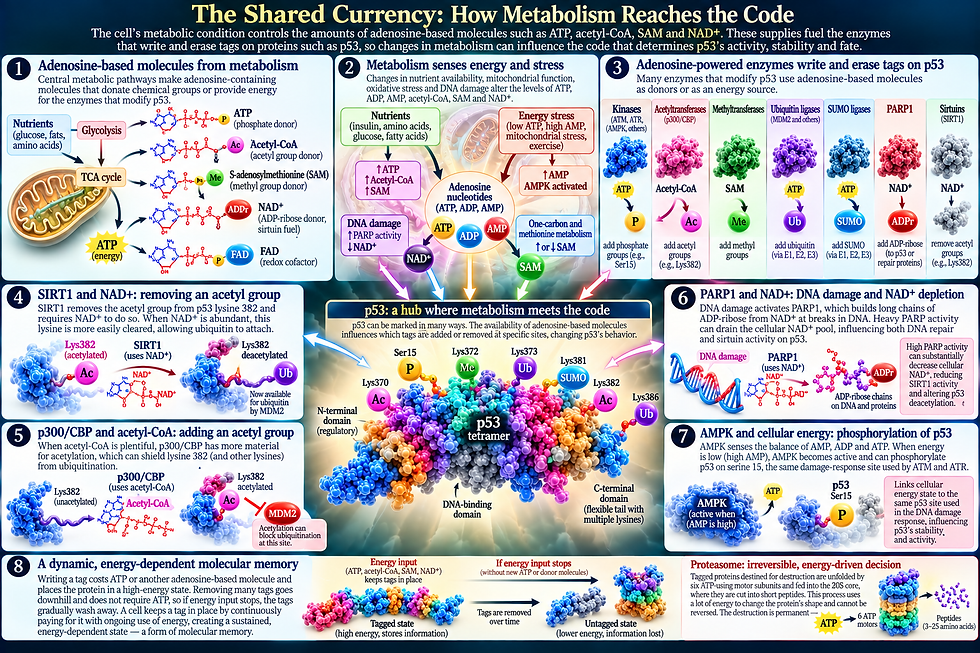
A protein such as p53 can be marked in many ways, and nearly every kind of mark is delivered by a molecule that contains adenosine. Phosphate groups come from ATP, handed over by kinases. Acetyl groups come from acetyl-CoA, and coenzyme A contains an adenosine diphosphate unit. Methyl groups come from S-adenosylmethionine, which is adenosine joined to the amino acid methionine. Ubiquitin and its relatives SUMO and NEDD8 are all activated by ATP-using E1 enzymes. ADP-ribose groups come from NAD+, whose backbone is an adenosine nucleotide, and the sirtuin enzymes that remove acetyl groups also burn NAD+ to do it. The redox cofactor FAD carries an adenosine monophosphate too.
This matters for p53 because its flexible tail has a handful of lysine amino acids, at positions 370, 372, 373, 381, 382 and 386, that can be marked with acetyl groups, methyl groups, ubiquitin or SUMO. Think of each lysine as a parking space and each tag as a car. The cars compete for the same spaces, and every one of them was fueled and delivered by an adenosine-based truck. Which tag occupies the space helps decide whether p53 is stabilized or destroyed. In this sense, adenosine is not just a cofactor in the ubiquitin code but the ink of the whole modification language that ubiquitin is competing within. Calling it a single “ink” is describing a pattern in it.

The Direction: Energy as Memory
Writing a tag costs ATP and removing it is the downhill direction without the need for ATP, carried out by enzymes that cut ubiquitin off, strip phosphates, or take away acetyl groups without using more energy. If the writing stopped, the tags would wash away. A cell that keeps a tag in place is therefore a cell that keeps paying for it with ongoing use of energy, and the pattern of tags at any moment is a state held away from equilibrium by continuous energy input.
This is why a tagged protein can carry information about what has happened to it recently. The proteasome, which destroys tagged proteins, is likewise driven by six ATP-using motor subunits that unfold its targets and feed them into the cutting chamber, which makes degradation a one-way event. In effect the system’s memory and its irreversible decisions are both made possible by adenosine nucleotide hydrolysis. Molecular Memory of tagging is a sustained, energy-dependent state.
The process uses a lot of energy to physically change a protein's shape and the cleanup process cannot be reversed once it starts. The cell marks worn-out or faulty proteins with a chemical "trash tag" (called ubiquitin) so the cell knows they need to be destroyed by the proteasome. The entrance to the proteasome uses six tiny motors each using an ATP. Proteins are tightly folded, complex shapes. The motors use the energy to untangle and straighten them out so they can fit into the machine. The straightened protein is pushed into the center of the proteasome, which acts like a biological paper shredder to chop the protein into tiny pieces. Because the protein is mechanically unfolded and chopped up using energy, it cannot spontaneously put itself back together. The destruction is permanent, a one-way even.

The Shared Currency: How Metabolism Reaches the Code
Because so many tag-writers and tag-erasers draw on adenosine-based supplies, the cell’s metabolic condition can seep into the code.
The sirtuin SIRT1 removes the acetyl group from p53 lysine 382 and needs NAD+ to do so, so when NAD+ is abundant that lysine is more easily cleared for ubiquitin.
When acetyl-CoA is plentiful, p300/CBP has more material for acetylation, which can shield those same lysine amino acids.
DNA damage itself draws on the pool, because the enzyme PARP1 builds long chains of ADP-ribose from NAD+ at breaks in DNA, and heavy PARP activity can drain NAD+ substantially.
And AMPK, the cell’s sensor for the balance of AMP, ADP and ATP, can phosphorylate p53 on serine 15, tying the energy state to the same damage-response site that ATM and ATR use.
The Sensor: Reading the Handle
Adenosine is not only spent by this system. It is also read. A large family of motor proteins called AAA+ ATPases change shape depending on whether they have ATP or ADP bound.
Dynein, the walking cellular motor, uses a ring of AAA+ ATPases.
The proteasome’s motor ring and the enzyme that extracts proteins from membranes and chromatin belong to this family.
So does a particular giant ubiquitin ligase involved in defense against bacteria, viruses and parasites. This giant ligase becomes active when ATP binds its AAA core, that its ligase activity rises and falls reversibly with the cell’s ATP level. That interferon raises ATP in macrophages and primes the enzyme. In this way ATP is a danger signal for the cell’s innate defenses.
When tissue is damaged, ATP leaking from injured cells activates purinergic P2 receptors on neighbors and acts as an alarm, and enzymes on the cell surface then convert that ATP into adenosine, which switches the message toward calming and repair. This ATP-to-adenosine two-phase switch is one of the best-studied signaling systems built on adenosine. This ligase is similar, but inside the cell.

When the Handle Itself Becomes the Message
Two languages also meet directly. The two post-translational modification (PTM) signaling systems, or languages, are ubiquination and ADP-ribosylation (PAR signaling). Ubiquitination is the biological "code" where the small regulatory protein ubiquitin (or chains of ubiquitin) is attached to targets to regulate processes such as protein degradation, localization, and DNA repair. PAR signaling is the biological code synthesized by enzymes like PARP (poly-ADP-ribose polymerase) using NAD⁺ to build mono- or poly-(ADP-ribose) polymers at DNA damage sites as a repair beacon.
At breaks in DNA a critical nuclear enzyme in human cells detects DNA damage and coordinates the cellular repair process. It does this by building polymers of ADP-ribose, which are essentially chains of adenosine-derived units. Some ubiquitin ligases can read these chains. The large ligase recognizes poly-ADP-ribose and then ubiquitinates the proteins attached to it.
The bacterium Legionella pneumophila uses NAD+ to attach ubiquitin to host proteins by a route that bypasses the E1, E2 and E3 enzymes entirely, and it releases AMP when it does so.
Another family of ligases have been reported to attach ubiquitin to ADP-ribose itself. Here the ubiquitin language is being written onto molecules built from the same adenosine unit that powers the language.

The Supply Chain: Adenosine Builds the Builders
Every protein of the ubiquitin system is made by a ribosome, and adenosine is present at each stage of that process. Transfer RNAs are loaded with amino acids through the biochemical reactions involving adenosine monophosphate derivatives described above, and the amino acid is attached to the terminal adenosine of the tRNA. The ribosome’s catalytic center is made of RNA, and its three-dimensional architecture is held together in large part by interactions, in which adenosines tuck into the grooves of neighboring RNA helices, a motif that features prominently in the structural work on RNA architecture.
Even the ubiquitin gene supply is tied to the ribosome, since two of the four human ubiquitin genes make ubiquitin fused to ribosomal proteins. Having two human ubiquitin genes fused to ribosomal proteins means the cell links the production of ubiquitin directly to the creation of ribosomes, helping build and regulate protein-making factories efficiently.
The ubiquitin tag acts as a chaperone or helper protein. It guides the ribosomal proteins (eL40and eS31) so they fold correctly and fit into developing ribosomes.
Cells need a steady, high supply of both ubiquitin (for tagging and destroying waste proteins) and ribosomes (for making new proteins). Fusing the genes lets the cell produce both components in equal, balanced amounts. Once the fused protein is translated, cellular enzymes chop it apart. This releases free, functional ubiquitin alongside the mature ribosomal protein ready for assembly
Adenosine therefore builds the machinery, activates the tag, supplies the ink, powers the readers and, in at least one case, reads as a signal.

Adenosine Intelligence and Ubiquitin's Vast Language
The ubiquitin system is a strong and well-documented case of the pattern of adenosine producing many otherwise unrelated chemical systems. Adenosine moved in these many directions very early, probably before the last universal common ancestor, and all of these adenosine activities were then inherited by later lineages. Adenosine’s chemistry made it the obvious direction repeatedly and independently.
The ubiquitin system looks at first like an invention of eukaryotic cells, a vocabulary of chains and receptors with no obvious relatives. Looked at from underneath, it is built on the oldest and most reused piece of chemistry in the cell. Its tag is activated by an adenosine handle, its competing marks are delivered by adenosine carriers, its direction is set by adenosine hydrolysis, its machines are made by adenosine-rich RNA, and at least one of its enzymes reads adenosine as news. The intelligence of the ubiquitin system is dramatic and a good share of what makes that intelligence possible was already in place in the intelligence of the molecule adenosine.