NF-kB – Increasing Intelligence from DNA Binding Protein to Central Switchboard of Immunity

Every time you cut your finger, catch a cold, or feel the ache of an inflamed joint, a family of proteins called NF-κB is making decisions inside your cells. It decides whether a cell should sound an alarm, which alarm to sound, how loudly, and for how long. In a human immune cell, that decision passes through dozens of proteins arranged in layered circuits. The system did not begin that way. It began with one molecule that could do little more than bind DNA, and it acquired its present sophistication one mechanism at a time over a billion years.
Reading that history in order reveals something striking. Each new mechanism did not simply add a part. It added a new capacity: to wait, to be released on command, to listen to many signals at once, to keep time, to speak in combinations. With each capacity, the system became able to tell more situations apart and to respond to each more fittingly. That is the way the molecule NF-κB gained intelligence. NF-kB joined mTOR, AMPK, and p53 as perhaps the most intelligent molecular complexes in the cell, able to make the most complex vital decisions.
The ancestor: a molecule that could read DNA
The core of the NF-κB protein is a region of about 300 amino acids called the Rel domain (this name comes from the virus where it was originally discovered). Its front half grips DNA. Its back half lets two NF-κB proteins for a pair, the form that actually binds. The pair recognizes a short stretch of DNA about ten base pairs long, the κB site, whose major sequence reads GGGRNWYYCC. Near the end of the domain sits a small cluster of positively charged amino acids, the nuclear localization signal, which works as an entry ticket into the nucleus.
This domain is older than animals. NF-κB proteins have been reported in single-celled amoeboid relative of animals. What these early forms could do was a basic job: pair up, enter the nucleus, and turn on genes near κB sites. It was a molecule that could bind and activate but was not yet able to discriminate. If it was present, it acted.

The first capacity: restraint
The first great innovation was self-restraint. The NF-κB gene became joined to a molecule that had encoding ankyrin repeats. An ankyrin repeat is a small unit of about 33 amino acids folded into two short helices and a loop. Stacked in a row, several repeats form a curved surface that grips other proteins, like velcro. Ankyrin repeats are among the oldest and most widespread interaction modules in biology, used by bacteria and by human chromatin regulators alike.
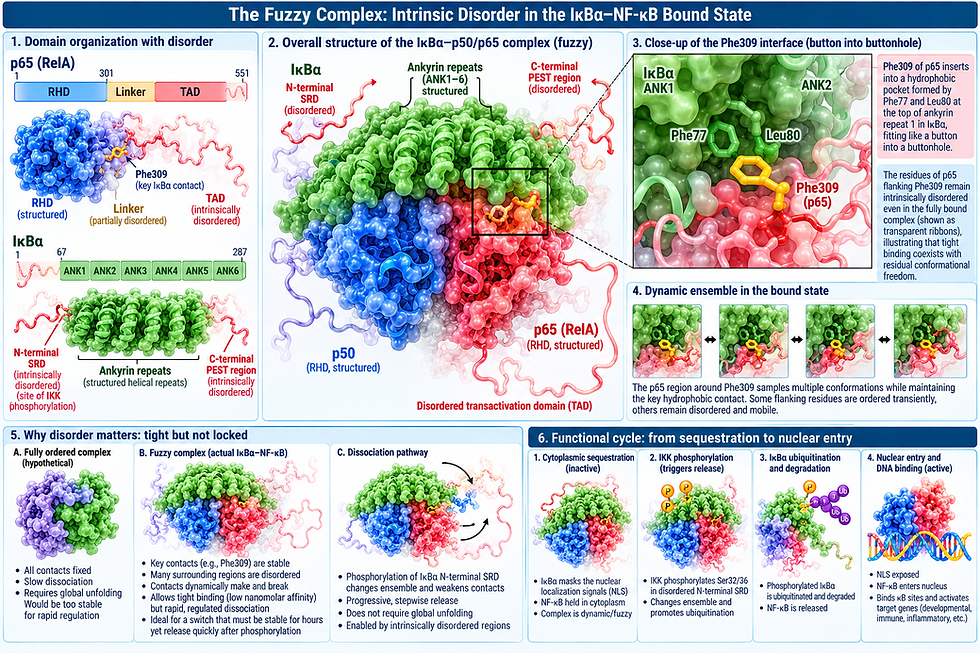
Attached to the tail of NF-κB, the ankyrin repeats folded back and gripped the molecule's own Rel domain, covering its nuclear localization signal. The nuclear localization signal is a short stretch of basic amino acids (such as lysine and arginine) that act as a "zip code" recognized by importin receptors to transport the protein through the nuclear pore complex into the nucleus. In resting cells, the inhibitor protein binds to this exact region, physically masking the NLS to keep the transcription factor inactive and sequestered in the cytoplasm until a cellular signal triggers IκB degradation. With the ankyrin repeats, the protein held itself in the cytoplasm. Molecules of this self-inhibited type exist today in corals and in the sea anemone, and in our own cells as the precursor proteins p105 and p100.
Restraint is useless without a way to release it. The release mechanism of the self-inhibited form is elegant. When a signal arrives, a kinase adds phosphate groups near the ankyrin region, marking the protein to be destroyed by the proteasome, the cell's protein-shredding machine. The proteasome does not destroy the whole molecule. It chews away the inhibitory tail and stops, releasing the DNA-binding portion, which is now free to enter the nucleus. This partial processing converts the molecule p105 into the p50 molecule and p100 into p52 in human cells.
This was the first real gain in the molecule’s judgment. A molecule that always acts cannot distinguish one situation from another. A molecule that waits in readiness and acts only when a specific event removes its restraint, has made its action conditional. It carries in its own structure the difference between "not now" and "now."
There was a cost: the release is one-way. Once the tail is cut off, it cannot be reattached, so each molecule can make its decision only once.

Early animals: one mechanism, two uses
Even in some of the simplest animals, NF-κB already served two very different purposes. It was required for the development of stinging cells and it, also, responded to pathogens and stress. At this stage the molecule's decision was generic: release, enter, activate. What the activation meant depended on which cell it happened in and which genes were accessible there. As the story continues, later innovations let the NF-κB system itself to contribute more and more to choices about actions and where it occured.
The second capacity: an independent brake and a sense of time
The next major step separated the brake from the engine. Instead of carrying its ankyrin repeats on its own tail (both being produced from the gene as one protein, rather than two separate molecules) NF-κB came to be held by a separate protein made from its own independent gene, called IκB, or "inhibitor of κB." An IκB is essentially the ankyrin domain set free: a chain of about six repeats that wraps around an NF-κB pair and masks the nuclear localization signal. Species developed an NF-κB lacking the ankyrin tail and a separate IκB-like protein. In humans there are now IκBα, IκBβ, and IκBε that occur in the cytoplasm. Another group occur in the nucleus including Bcl-3, IκBζ, Bcl3L1 and IκBδ. There are, also, large precursor proteins of the NF-κB family that contain C-terminal ankyrin repeat domains that allow them to function exactly like IκB proteins. They bind and trap active NF-κB subunits in the cytoplasm until they are processed by enzymes. These include p105 (precursor to p50) and p100 (precursor to p52).
Making the brake a separate molecule changed what the system could do in three ways. First, the brake could be destroyed completely while the engine survived intact, so NF-κB was no longer used up in making one decision. Second, the brake's gene could be regulated on its own. Third, and most important, the IκB gene could itself be switched on by NF-κB. When NF-κB enters the nucleus, one of the genes it activates is the gene for its own inhibitor. Newly made IκBα moves into the nucleus, pulls NF-κB off the DNA, and escorts it back to the cytoplasm.
This is a negative feedback loop, and it gave the system something it never had before: a sense of time. A response now has a built-in ending, unless the signal persists and keeps destroying each new batch of inhibitor. The system, like p53, could now tell a passing disturbance from a sustained one.
The inhibited complex is not locked in place. IκBα carries its own nuclear export signal, and NF-κB–IκB complexes shuttle continually between cytoplasm and nucleus, with export winning out. "Sequestration" is a steady state of motion rather than a prison, which is part of why the system can respond so quickly when the balance tips.

The third capacity: a switchboard
Once the brake was a separate protein, signals needed a way to remove it. The answer was a dedicated kinase complex, the IκB kinase, or IKK. It consists of catalytic subunits, of which IKKβ is the key one, held together with a regulatory scaffold protein called NEMO. When activated, IKK adds phosphates to two specific amino acids on IκBα, serine 32 and serine 36. That phosphorylated pair is recognized by a ubiquitin ligase called SCF-βTrCP, which tags IκBα with a chain of ubiquitin, and the proteasome destroys it within minutes. NF-κB is free.
IKK is not a late addition. IKK-like kinases and NEMO-like proteins is an old component that was later expanded.
The significance of IKK is that it is a point of convergence. Many different receptors, sensing bacteria, viruses, damaged tissue, or messages from other cells, feed into a small number of adapter proteins that all lead to IKK. The system now integrates. It can take in many kinds of information and reduce them to a single question: should the brake come off? The molecule IKK became a vast decision making tool where many signals converged on one decision to take off the brake.

The fourth capacity: specialization and graded meaning
In the lineage leading to fruit flies, the NF-κB family expanded to three members, each with a distinct job. This three-member arrangement is characteristic of flies; many other insects, including beetles and honeybees, have only two.
The first, the NF-kB molecule in flies called Dorsal is famous among developmental biologists. In the early fly embryo, a signal on the belly side releases Dorsal, but to different degrees across the embryo, so that nuclear Dorsal forms a gradient from belly to back. Cells read their position from how much Dorsal they contain. Where it is highest, it switches on a set of genes whose cells become muscle. At intermediate levels it activates other genes, and where it is low it has little effect. Here, for the first time in this story, NF-κB is more than an on-off switch. Its quantity carries information, and the genome reads that quantity through binding sites of different strengths.
The second, Dif, is a fly-specific duplicate of Dorsal, works with Dorsal to carry the immune signal from the Toll receptor pathway, which responds mainly to fungi and certain bacteria and turns on antimicrobial peptides.
The third member, Relish, runs a separate pathway called Imd, which responds to other bacteria and activates peptides. Relish is the ancestral self-inhibited type with its own ankyrin tail. It is activated by having that tail cut off, by a protease working together with IKK phosphorylation. The oldest mechanism was kept and given a lane of its own.
With three members wired to different inputs, the fly can distinguish kinds of threat and respond with different weapons, while the same family builds the body plan in the embryo.

The fifth capacity: vocabulary, speeds, and rhythm
In the ancestors of vertebrates, two rounds of whole-genome duplication multiplied the family again. Humans have five NF-κB proteins in two classes. RelA (also called p65), RelB, and c-Rel carry transactivation domains that recruit the machinery for switching genes on. The other two, p105 and p100, are the ancient self-inhibited type. When processed they become p50 and p52, which lack strong activating domains of their own.
Because NF-κB works as a pair, five subunits can form up to fifteen different dimers. These differ in which κB sequences they prefer, which partner proteins they recruit, and whether they activate or repress. A p50–p50 pair can occupy a site and block it, while a RelA–p50 pair activates strongly. The family now has a vocabulary.

The brakes multiplied as well. IκBα, IκBβ, and IκBε work in the cytoplasm with different rates of destruction and re-synthesis, giving the system fast and slow responses. Nuclear IκB proteins such as Bcl-3 and IκBζ act at the genes themselves, changing which targets a given dimer turns on. The kinase split too. IKKα and IKKβ arose by duplication. IKKβ with NEMO drives the fast canonical pathway. IKKα, activated by a kinase called NIK in response to a restricted set of receptors, drives a slower different pathway whose job is to process p100 into p52, releasing RelB–p52 pairs. Vertebrates thus took the most ancient release mechanism of all, the partial processing of a self-inhibited precursor, and made it a separate, slower channel devoted to building lymph nodes and maturing B cells.
Control around IKK also became more intricate. Signals now pass through ubiquitin chains used not as destruction tags but as scaffolds. Chains linked through lysine 63, and "linear" chains, built head-to-tail by a complex called LUBAC, assemble the activating machinery. An enzyme called A20, itself switched on by NF-κB, edits these chains and turns signaling down, adding a second feedback loop beside IκBα.
These feedback loops give vertebrate NF-κB a rhythm. Measured in single living cells, nuclear NF-κB often rises and falls in oscillations with periods of roughly one to two hours, driven largely by IκBα re-synthesis. Different stimuli produce different patterns: a single brief pulse, repeated oscillations, or sustained activity. Genes respond differently to these patterns. Some fast-responding genes switch on with any pulse, while others need prolonged activity to open tightly packed chromatin. The same proteins can therefore carry different messages through timing alone, and the genome is organized to decode them.
Finally, the system was wired into adaptive immunity. When a B cell or T cell receptor recognizes its specific antigen, the signal passes through a complex of three proteins to IKK. The ancient decision machinery now serves the most specific recognition system in biology.

What kind of intelligence?
One aspect of intelligence is the ability to distinguish situations and respond to each appropriately. The history of NF-κB is an accumulation of many new distinct capacities. The ancestral molecule could recognize DNA and act. Self-inhibition gave it restraint, making action conditional on a signal. A separate inhibitor made the brake independently controllable and, through feedback, gave responses a beginning and an end. IKK made the system an integrator, gathering many inputs into one decision point. Duplication created parallel channels for different threats and let quantity carry meaning. In vertebrates, pair combinations provided a vocabulary, multiple inhibitors and two kinase pathways provided different speeds, and feedback-driven dynamics allowed information to be carried in time.
The capacity of the whole system to discriminate grew at every stage, and it grew by repeated duplications. An existing component was duplicated, and the copy was given a new role or a new partner. The intelligence lies in the architecture, distributed across many molecules rather than located in any one of them.
In the ancestral system NF-κB mostly signaled and the cell's context supplies much of the meaning. In the modern system, the NF-κB family contributes substantial meaning of its own, through which dimers form and how their activity unfolds in time, while the chromatin of each cell determines how that message is read. Meaning is made jointly.
Through all of this, the core logic never changed. A signal arrives. The restraint is removed. The molecule enters the nucleus. The decision is made. What changed across a billion years was how many different signals could be heard, how finely the release could be graded, how long the answer lasted, and how many different answers there were to give. The cell is no longer what it was, and over evolutionary time, neither is the molecule.