
AMPK and The Increasing Intelligence of Molecules
Updated: Sep 7
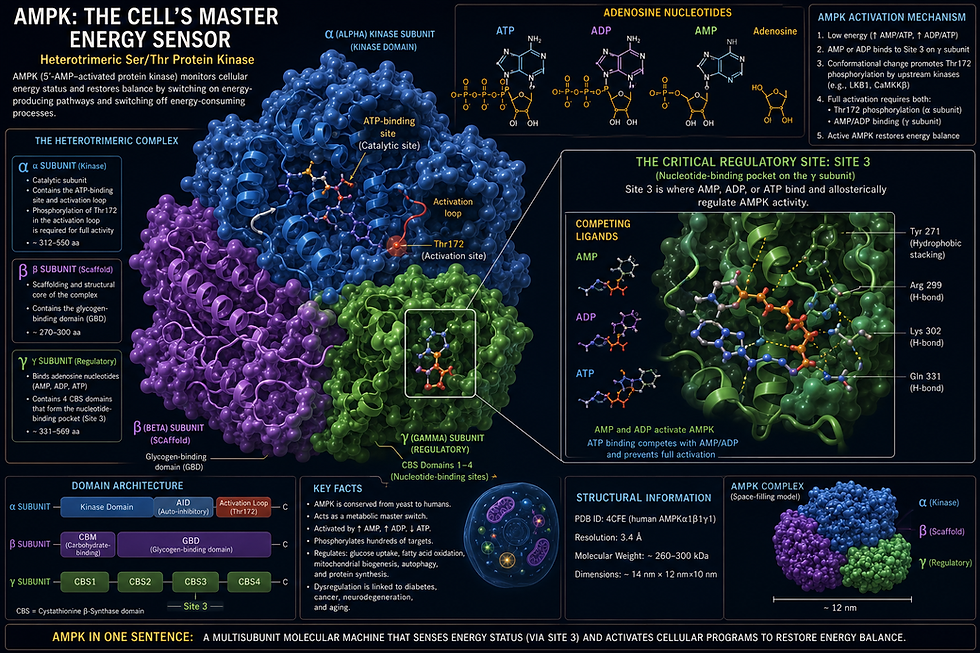
From a Primitive Energy Sensor to the Master Guardian of Cellular Energy
Long before animals, plants, or the first eukaryotic cells existed, bacteria and archaea already decided the best to use their energy. Every cell continuously judged whether enough ATP was available to build new molecules, or whether scarce resources demanded conservation and repair instead.
Early life responded to energy availability, but it did so through many separate, local biochemical sensors rather than one central system. Energy information was distributed throughout the cell. Many prokaryotic enzymes bound ATP directly, and when ATP levels fell, those enzymes simply slowed down because their substrate became less available — the chemistry itself changed, with no dedicated sensor required.
Bacteria possessed some specialized global regulatory systems. During amino acid starvation or other stresses, alarm molecules accumulated and reprogrammed the cell: ribosome production slowed, DNA replication was reduced, and metabolism shifted toward survival. This was not AMP sensing in the modern sense, but it was an ancient, global indicator that the cell's resources had become insufficient.

One way prokaryotic cells monitored energy was through proteins that bind ADP or AMP directly. As the balance between ATP, ADP, and AMP shifted, the shape and activity of those proteins changed with it. Each protein sensed the local energy state for itself, without reporting to any central controller. Another ancient system involved proteins that integrated ATP, ADP, and key metabolic intermediates to regulate nitrogen assimilation and related metabolic processes. They coordinated an important branch of metabolism while responding to the cell's overall energetic condition. Many bacterial transcription factors also responded directly to the cell's energy state, detecting ATP-dependent changes in DNA topology, membrane potential, or metabolite concentration.
Together, these systems formed a distributed network of energy sensing — not organized around a single hub, but working through the coordinated monitoring of nutrient availability, metabolism, growth, and environmental stress. These early kinases functioned as primitive metabolic decision-makers: when nutrients became scarce, growth slowed and survival pathways took over.
As bacterial metabolism grew more sophisticated, additional layers of regulation became necessary. Protein kinases began integrating signals from multiple metabolic pathways rather than responding to a single chemical input. Instead of acting as simple on-off switches, some became hubs coordinating carbohydrate metabolism, fatty acid synthesis, amino acid production, membrane biosynthesis, and oxidative stress responses all at once. These ancestral enzymes laid the foundation for one of biology's most important regulatory systems — becoming increasingly capable of communicating across cellular functions rather than acting in isolation.

Eukaryotic Cells — Roughly Two Billion Years Ago
The emergence of eukaryotic cells around two billion years ago transformed the challenge of energy management. Early eukaryotes were far larger, acquired mitochondria and nuclei, developed extensive internal membrane systems, and began transporting cargo over long intracellular distances. Local energy decisions were no longer sufficient — one region of the cell might have abundant ATP while another did not. Growth, division, autophagy, mitochondrial biogenesis, and metabolism all needed to be coordinated across the entire cell at once.
The acquisition of mitochondria dramatically increased ATP production but also introduced new complexity. Cells now contained internal organelles, membrane trafficking systems, cytoskeletal networks, and much larger genomes, all demanding constantly shifting energy supplies. Energy regulation could no longer depend on a single kinase acting alone; it required a molecular decision-making complex capable of integrating many signals simultaneously.
This growing cellular complexity created pressure for a centralized energy coordinator, and AMPK emerged by combining an ancient kinase with two new regulatory subunits — beta and gamma — into a single molecular hub capable of measuring cellular energy status and coordinating metabolism cell-wide.
AMPK did not invent energy sensing; it centralized it. Early life already responded to energy availability through many distributed, local sensors. AMPK represents the transition from that distributed network of individual energy-sensitive proteins into a unified cellular "energy executive" that integrates those signals and orchestrates a coherent, organism-wide response.

The ancestral kinase, which became AMPK's alpha subunit, retained its ancient catalytic activity but gained two regulatory partners that transformed its capabilities. A beta subunit organized the complex structurally and anchored it to specific locations in the cell. A gamma subunit, containing domains that bind to adenosine based energy molecules (called CBS for cystathionine beta-synthase), emerged as an exquisitely sensitive energy sensor capable of binding AMP, ADP, and ATP. These nucleotide-binding pockets converted AMPK from a simple kinase into a molecular gauge of the cell's energetic state.
The Original Kinase: Precursor of the Alpha Subunit
The ancestral alpha subunit was simply a kinase that added phosphates to proteins. It had no direct way to sense cellular ATP levels. It possessed a single kinase domain with a limited substrate range, no auto-inhibitory domain, no regulatory extension, and no binding to other subunits—its activity was not tightly regulated and responded only to its immediate local context.
Once the gamma energy sensor and beta scaffolding subunit were added, this simple kinase was transformed into an integrated decision-making system. Its substrate range expanded from a handful of targets to more than a hundred distinct phosphorylation targets across as many pathways. It gained an autoinhibitory domain. And critically, it gained the ability to be activated by the ratio of AMP to ATP—not by sensing this ratio itself, but through its physical connection to the new gamma subunit, which did the sensing on its behalf.
The modern alpha subunit no longer acts independently. It continuously receives structural and biochemical input from the gamma and beta subunits, as well as independent kinases from other significant signaling pathways acting on its activation loop, and integrates all of this into a single coordinated output: whether the cell should grow, conserve resources, or enter an energy-saving state.

The activation loop—a short, highly mobile segment within the kinase domain—normally partially blocks the catalytic site. Its position is directly affected by shape changes transmitted from the other two subunits. When AMP or ADP binds the gamma subunit, gamma changes shape; that change is relayed through the beta subunit and stabilizes the alpha activation loop in the correct position. When a totally different kinase with a different stream of information then phosphorylates a specific amino acid within that loop, the loop locks into its active conformation. This single flexible loop functions as AMPK's core molecular switch.
A second, related mechanism operates at the structural interface between the alpha and beta subunits, forming a pocket that allows AMPK to sense certain small-molecule activators and lipids directly. This second signal either reinforces or acts independently of the nucleotide-based signal coming from the gamma subunit.
The New Beta Subunit
The beta subunit began as an entirely independent molecule with no connection to alpha or gamma at all — a carbohydrate-binding protein involved in general cellular metabolism, built around a carbohydrate-binding module (CBM) that let it dock onto glycogen and starch. It had no role in phosphorylation-based kinase regulation.
Over time, this ancestral beta subunit's structural regions were repurposed. New loops transformed it from a passive physical bridge into an active participant in signaling, giving it the ability to bind and coordinate both the alpha and gamma subunits as well as AMP itself.

Today, the beta subunit is a molecular bridge connecting energy sensing to subcellular location. Its carbohydrate-binding module lets AMPK dock directly onto glycogen particles, sensing long-term carbohydrate reserves, while a separate, more flexible region of the same subunit acts as a conformational switch that helps determine whether the catalytic engine is on or off. This dual design—a rigid, sequence-specific glycogen-docking domain paired with flexible structural arms—lets AMPK monitor long-term energy reserves (glycogen) and transmit the shape changes that flip the catalytic switch when immediate energy (ATP) drops, at the same time.
How can the beta unit add totally new activities that are part of intelligent coordination of inputs without the molecules knowing what was needed?
The New Gamma Subunit
The gamma subunit, too, began with no connection to the other two. In its earliest form it likely contained a single CBS domain, binding AMP fairly well but ADP and ATP only weakly. Duplication of this domain — producing two, and eventually four CBS domains arranged as two tandem CBS-domain pairs—created a module able to sense AMP, ADP, and ATP simultaneously, with the four sites cooperating in a single, integrated regulatory readout.
The gamma subunit is AMPK's primary sensory module. Where the catalytic alpha subunit is the motor and the beta subunit is the scaffold and fuel-docking station, gamma is the direct adenosine based energy gauge, quantifying the relative amounts of the adenosine based molecules ATP, ADP, and AMP, continuously measuring the cell's immediate energy state.
As AMPK gathered more abilities and intelligence, the gamma subunit's four nucleotide-binding sites took on distinct roles. One site binds all three nucleotides reversibly, functioning as a dynamic sensor. One site is thought not to bind nucleotides at all. A third is the primary regulatory switch: AMP or ADP binding here triggers the conformational change that both activates the kinase and protects it from being switched off. A fourth binds AMP tightly and essentially permanently, acting as a structural anchor stabilizing the subunit's overall fold.

The gamma subunit translates nucleotide binding directly into catalytic activity. When intracellular energy drops and AMP or ADP displaces ATP at gamma's regulatory sites, the resulting shape change is transmitted across the whole complex, pulling on the catalytic alpha subunit and boosting its intrinsic activity as much as tenfold, even before any additional
phosphorylation occurs.
How can this totally new structure and ability to communicate among new molecules occur without the molecules knowing what is needed?
Integrating Multiple Signals at Once
Because sensory duties are distributed across all three subunits, the complete AMPK heterotrimer functions less like a simple switch and more like a small biological computer, processing several independent physical, chemical, and spatial inputs simultaneously.
The gamma subunit senses the ratio of AMP, ADP, and ATP. Because AMP and ATP compete for the same binding pockets, the complex flips between two structural states depending on which nucleotide wins out. When ATP is abundant and occupies these sites, the catalytic domain rotates into an open conformation that exposes the activation loop, allowing cellular phosphatases easy access to strip its phosphate group and shut the kinase down. When energy runs low and AMP rises sharply, AMP displaces ATP from these pockets, drawing the alpha subunit's regulatory arms in tight against gamma. This folds the complex into a compact, protected structure that shields the activation loop from phosphatases—and, independent of that physical protection, AMP binding also distorts the active site in a way that greatly increases the enzyme's baseline catalytic rate, up to tenfold.

The beta subunit contributes a second input by sensing glycogen availability directly: its carbohydrate-binding module docks onto glycogen particles, and high glycogen levels suppress AMPK activation, while depleted glycogen reserves release or reorient the complex, signaling that long-term fuel stores are running low.
The alpha subunit contributes a third input channel, since its activation loop is a target for other vital kinases from important pathways responding to signals unrelated to adenylate ratios. One such input concerns metabolic stress and tumor suppression, and a second brings in intracellular calcium flux, signaling muscle contraction or neuronal activity independently of any change in ATP.
These three input channels don't act separately—they multiply and modulate one another. If calcium-driven alpha-subunit activation coincides with AMP binding at gamma, the resulting activation is not merely additive but exponentially greater. If ATP drops only slightly while glycogen stores (sensed by beta) remain full, the glycogen signal dampens the response, preventing the cell from overreacting prematurely. And because the beta subunit also carries a lipid anchor, it lets AMPK register where in the cell a given signal is occurring—at the lysosome, the nucleus, or a glycogen granule — adding a spatial dimension to the three chemical inputs. Once activated by any combination of these signals, alpha can go on to phosphorylate well over a hundred distinct downstream substrates.
How does a molecule change from a simple switch to a biological computer without using mind?
Spreading the Signal Across the Whole Cell
A single AMPK molecule acts on only one substrate at a time. The alpha subunit's catalytic site, only about 300 amino acids long, contains one ATP-binding pocket and one substrate-binding groove. At any given instant it transfers a single phosphate from ATP to a serine or threonine amino acid on one molecule that it is stimulating, a reaction lasting only milliseconds. That molecule then immediately dissociates and another molecule takes its place for the next reaction. Over the course of a few minutes, one AMPK molecule can phosphorylate hundreds to thousands of separate protein molecules this way.
It can recognize so many different targets because most AMPK substrates share a similar phosphorylation motif rather than an identical sequence—many otherwise unrelated proteins have independently evolved a comparable "landing pad" that fits AMPK's catalytic cleft, even though the proteins themselves differ widely in structure and function.

This capacity to stimulate more and more molecules keeps expanding because a cell contains not one AMPK molecule but thousands of individual AMPK complexes distributed across the cytoplasm, nucleus, and organelle membranes. When energy levels fall, many of these complexes are activated together—for instance, through phosphorylation of the alpha activation loop across the whole population—producing a large, parallel response rather than a single enzyme working through a sequential checklist. One activated complex might shut down fat synthesis at the endoplasmic reticulum while another initiates autophagy at the lysosome and a third acts on transcription factors in the nucleus, all simultaneously. This combination of a large, parallel fleet and rapid catalytic turnover per molecule is what allows a brief shift in the AMP-to-ATP ratio to rapidly rewire an entire cell's metabolism, shifting it from an energy-consuming state to an energy-conserving one within seconds.
Because each AMPK complex acts independently, activation doesn't have to be all-or-nothing across the whole cell. A concentration of AMPK anchored at the lysosome can respond to a local drop in glucose and trigger autophagy there before global ATP levels fall. A cluster near the contractile machinery in muscle can respond to a local calcium influx during contraction and boost glucose uptake without any cell-wide energy crisis. A population of AMPK in the nucleus can alter transcription in response to nuclear stress cues, independent of cytosolic AMPK activity. There is no chain reaction in which one AMPK molecule switches on the next; rather, the fleet behaves as a distributed sensory network, with widespread activation occurring during a genuine energy crisis and localized activation occurring when the underlying signal is itself local.
Advanced, Integrated Regulation
These innovations represented a major regulatory advance. Rather than merely detecting the presence or absence of nutrients, AMPK could now continuously monitor the relative concentrations of ATP, ADP, and AMP— and because even a modest drop in ATP produces a proportionally much larger rise in AMP, the complex became an unusually sensitive early-warning detector, able to initiate protective responses well before ATP became critically depleted.
As multicellular organisms developed, AMPK acquired numerous additional regulatory inputs. Calcium-dependent signaling became integrated, allowing muscle contraction, neuronal activity, and hormonal stimulation to activate AMPK even before ATP levels shifted appreciably. The tumor suppressor enzyme became a principal activator, linking cell polarity and growth control to energy regulation within a single network. The actions of multiple different enzymes further refined AMPK's behavior, letting cells distinguish between exercise, fasting, hypoxia, oxidative stress, inflammation, and simple nutrient deprivation.
How can a molecule know how to respond to many totally new inputs without mind?

AMPK's diverse actions expanded alongside increasingly complex multi-cellular organisms. Originally devoted mainly to slowing metabolism during scarcity, it gradually became the coordinator of cellular energy economics broadly: suppressing ATP-consuming building processes such as fatty acid synthesis, cholesterol production, glycogen synthesis, protein synthesis, and nucleotide biosynthesis, while activating ATP-generating breakdown pathways such as fatty acid oxidation, glucose uptake, glycolysis, mitochondrial biogenesis, and autophagy.
As tissues increasingly specialized, AMPK took on tissue-specific roles: stimulating glucose transport and mitochondrial adaptation in exercising skeletal muscle; suppressing glucose production and promoting fatty acid oxidation in the liver; regulating lipid storage and mobilization in adipose tissue; contributing to appetite regulation in the hypothalamus; shaping inflammatory responses, macrophage polarization, and T-cell differentiation in immune cells; and supporting axonal maintenance and stress resistance in neurons. For this new genes emerged to produce new specific versions of AMPK in specific tissues.
One of the most consequential developments was reciprocal regulation between AMPK and mTOR. AMPK became the guardian of energy conservation, repair, and survival during metabolic stress, while mTOR became the coordinator of growth, biosynthesis, and proliferation during nutrient abundance—the two systems locked in continuous molecular dialogue, restraining each other as conditions demand, most directly through AMPK's two independent routes to suppress mTORC1.
AMPK subsequently became integrated with circadian rhythms, mitochondrial quality control, redox biology, epigenetic regulation, and broader transcriptional networks, coordinating immediate metabolic adjustments with longer-term changes in gene expression and mitochondrial remodeling. Modern vertebrates possess multiple versions of each subunit, allowing many distinct subunit combinations to assemble in different tissues, each with somewhat different biochemical properties—fine-tuning metabolism across the whole body from what began as a single, simple kinase.

A Recurring Biological Theme of Increasing Intelligence
The history of AMPK illustrates one of biology's recurring patterns: complex regulatory systems don’t appear fully formed. Instead, new intelligent systems are built progressively on ancient simpler molecular foundations. A primitive kinase that once helped early cells survive starvation gradually accumulated regulatory domains, sensing partners, scaffolding subunits, totally new activators, new molecules stimulated, new versions for specific tissues, and extensive new signaling partnerships—each addition expanding its capacity to interpret the cell's energetic state and coordinate an increasingly sophisticated response. Each addition intelligently integrated into a larger more complex regulatory system. How can this occur with these molecules having intelligence?
Today, AMPK stands as one of the central decision-making hubs of the eukaryotic cell, continuously weighing ATP production against ATP consumption, integrating signals from nutrients, exercise, oxygen availability, hormones, oxidative stress, inflammation, and circadian timing, and coordinating metabolism from the level of individual enzymes up to whole organs. Across more than three billion years, it has transformed from a simple metabolic kinase into the master guardian of cellular energy homeostasis—a system that allows every cell to continually answer one of life's most basic questions: can it afford to grow, or must it first survive?
This kind of complexity doesn’t arise without a mind. The catalytic core—a bacterial-era molecular domain used to bind to an adenosine nucleotide and transmit a shape change, with no dedicated sensor protein at all — was the first to centralize nucleotide sensing into a single regulatory subunit with a single output. From there, the mammalian complex progressively added a three-way competitive nucleotide-reading mechanism in place of a cruder signal. Then it added two independent kinase inputs to the alpha unit extending its sensing beyond adenosine nucleotides into very significant calcium signaling and tumor-suppressor pathways. Eventually it added dozens of action targets reaching into lipid synthesis, cholesterol synthesis, autophagy, mitochondrial biogenesis, and glucose transport—while simultaneously being wired into reciprocal control with mTORC1.
None of these additions replaced what came before; each was layered on top of a still-functioning earlier mechanism, which is why modern AMPK activation is graded and multi-tiered rather than a simple switch. Nucleotide sensing via shapes of molecules, massive amplification of the signal by enzyme tagging, and target diversification all operate simultaneously. The single ancestral catalytic fold becomes, through successive recruitment of new partners rather than wholesale redesign, the hub that decides, across nearly every branch of cellular metabolism, whether the cell can afford to build or must instead conserve and consume itself. The sequence and mechanisms of each addition that produced the extreme cumulative complexity is completely documented in scientific research.
How can this molecule add so many diverse intelligent functions, one after another, leading to vastly increased complexity and a vastly increased ability to simultaneously regulate more and more data without the having mind?


