Who Controls Ubiquitin?

Ubiquitin is a tiny protein containing only 76 amino acids, yet it participates in an astonishing range of cellular activities. It helps determine which proteins are destroyed, which are moved, which signaling pathways are activated, how damaged DNA is repaired, whether inflammation begins or ends, when a cell divides, whether a damaged mitochondrion is eliminated, and sometimes whether the cell itself survives or dies.
How can the same tiny molecule mean so many different things?
The answer is that ubiquitin is more like a simple word whose meaning changes according to who writes it, where it is written, what surrounds it, who reads it, and when it appears. The cell contains hundreds of molecular agents that place ubiquitin on particular targets, dozens that help construct the message, many proteins that read the resulting structures, and roughly a hundred enzymes that can remove or reshape them.
This makes ubiquitin a distributed molecular intelligence.

One Tiny Protein With Many Meanings
Ubiquitin itself is remarkably simple and remarkably stable. Its 76 amino acids fold into a compact three-dimensional structure weighing only about 8.6 kilodaltons. At one end is a short flexible tail that provides the principal connection through which ubiquitin becomes attached to another molecule.
Ubiquitin also contains eight important places through which another ubiquitin can be attached to it. Seven are particular amino acids called lysines, conventionally numbered K6, K11, K27, K29, K33, K48, and K63. The eighth is the beginning of the protein, called M1.
The cell can attach one ubiquitin, several separate ubiquitins, a simple chain, a mixed chain, or a branching structure. Each arrangement presents a different three-dimensional surface to the proteins that encounter it.
Ubiquitin also contains several surface patches that other proteins use as docking sites. The molecule is therefore not merely a label. It is a physical object whose shape can be recognized.
The ubiquitin molecule has been almost constant and has develed enormously expanded the machinery around it.
The word stayed nearly the same. The language grew around the word.

Adenosine Powers the Language
At the bottom of the ubiquitin system is an even older molecular system: adenosine chemistry.
Before ubiquitin can be attached to anything, it must be activated. The first enzyme in the process uses ATP, the cell's major adenosine-containing energy molecule. ATP temporarily joins part of itself to ubiquitin, creating an activated intermediate. Energy from ATP therefore prepares ubiquitin for transfer.
This means that every new ubiquitin attachment begins with an expenditure of cellular energy. Constructing a chain requires repeated activation events and destroying a protein costs still more energy because the large molecular machine that unfolds the tagged protein also uses ATP.
The relationship with adenosine goes much deeper than this first activation step. Many of the other chemical tags that compete or cooperate with ubiquitin are also supplied by molecules built around adenosine. Phosphate groups are supplied by ATP. Acetyl groups are supplied by acetyl-CoA. Methyl groups are supplied by an adenosine-containing carrier called SAM. Another important regulatory molecule, NAD+, also contains adenosine and is used in reactions that add or remove other tags.
Thus, what initially looks like a collection of unrelated chemical languages shares a common metabolic foundation.
Adenosine helps make the proteins through the ribosome. It supplies energy for ubiquitin activation. It participates in delivering other competing tags. It powers the machines that destroy proteins. And through ATP, AMP, NAD+, SAM, and related molecules, it connects the tagging system with the cell's energetic and metabolic condition.
Ubiquitin is therefore not operating independently of metabolism. The ability of the cell to write and maintain molecular messages is tied to what the cell can afford.

How the Cell Chooses What to Tag
The basic ubiquitin pathway can be understood as a funnel.
Humans have only a very small number of enzymes that perform the first activation step. There are then roughly forty carrier enzymes. But at the final recognition stage there are more than six hundred different attachment enzymes, generally called ubiquitin ligases.
That extraordinary expansion tells us where much of the system's specificity lies.
The first enzyme activates ubiquitin. The second carries it. The third level decides which target should receive it.
These final recognition enzymes are therefore something like molecular matchmakers. They bring the ubiquitin-delivery machinery together with a particular protein at a particular time.
Different ligases accomplish this in somewhat different physical ways. Some mainly bring the carrier and target close enough for ubiquitin to pass directly between them. Others briefly receive ubiquitin themselves and then hand it to the target. A third group combines features of both mechanisms.
The cell separates the general problem of preparing ubiquitin from the much more difficult problem of deciding where it should go.
That is why there are only a few activating enzymes but hundreds of recognition enzymes.

The Target Must Be in the Right State
Even a recognition enzyme usually does not simply identify a protein by name. It frequently recognizes a temporary feature that appears only under particular conditions.
A target protein may expose a small recognition region when it changes shape. Another chemical tag may first have to be placed on it. Damage may uncover a normally hidden surface. The protein may have to enter a particular part of the cell. A partner may have to bind or leave.
These temporary recognition features are called degrons when they mark a protein for destruction. “I should be tagged only if this particular event has happened to me.”
One of the most common examples begins with phosphorylation. An enzyme first places a small phosphate tag on a protein. A ubiquitin ligase recognizes the phosphorylated form and then attaches the much larger ubiquitin tag.
The first tag therefore establishes a condition. The second can commit the target to a consequence.
This produces something resembling a molecular AND statement. The correct protein must be present, the appropriate small tag must have been written, the correct recognition enzyme must be active, and the ubiquitin-delivery machinery must be available.
Only when these conditions come together is the message written.

One Ubiquitin, Many Possible Messages
The next layer of information lies in the ubiquitin structure itself.
A single ubiquitin can alter the location or activity of a protein without destroying it. Several individual ubiquitins can be placed at different positions. Ubiquitin molecules can also be joined together into chains.
Different connections produce different shapes.
One of the best-known forms, the K48 chain, is strongly associated with protein destruction.
Another, K63, usually creates a more open structure and frequently serves as a platform on which signaling or DNA-repair proteins assemble.
M1-linked chains are particularly important in immune and inflammatory signaling.
K11 chains are important in cell division.
Other linkages participate in mitochondrial control and additional cellular processes that are still being worked out.
Chains can also mix different types of connections. They can branch. A single ubiquitin within a chain can have two other ubiquitins attached to different sites, producing a fork. The result is enormous combinatorial diversity.
But this should not be imagined as a rigid dictionary in which one chain always has one meaning. K48 is strongly associated with destruction, for example, but the full outcome still depends on the target, chain length, location, neighboring tags, available readers, and timing.
The ubiquitin “code” is therefore closer to a grammar than to a dictionary.
Readers Give the Tag Its Meaning
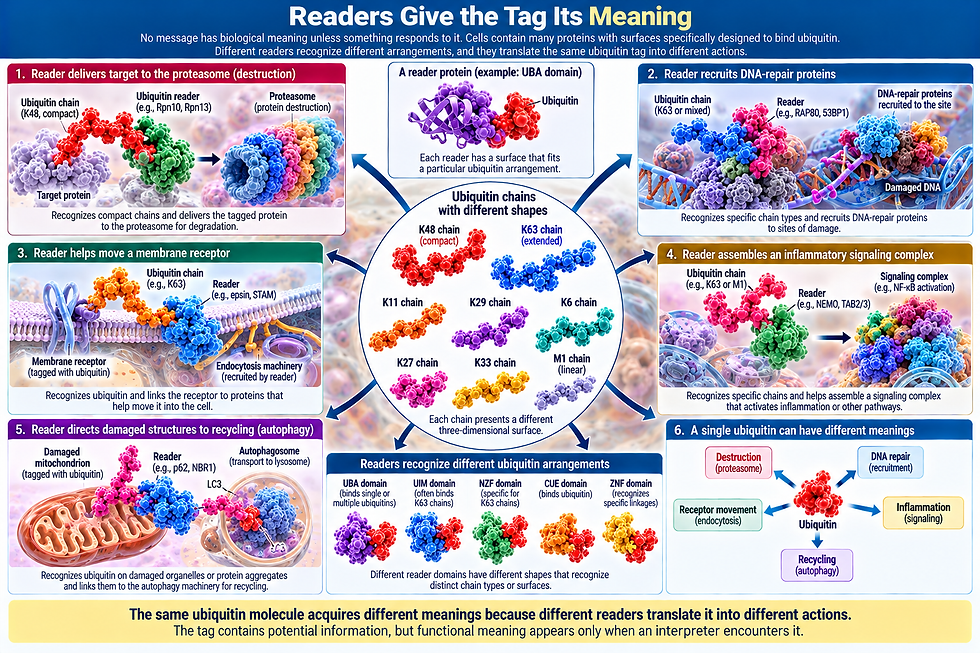
No message has biological meaning unless something responds to it.
Cells contain many proteins with surfaces specifically designed to bind ubiquitin. These are the readers of the system.
Different readers recognize different arrangements. Some favor compact chains. Others recognize extended chains. Some recognize a single ubiquitin. Some bind much more strongly when several ubiquitins are positioned at the correct distances from one another.
Once a reader binds, the consequences can be completely different.
One reader can deliver the target to the protein-destruction machinery. Another can recruit DNA-repair proteins. Another can help move a membrane receptor. Another can assemble an inflammatory signaling complex. Another can direct a damaged structure toward cellular recycling.
The same ubiquitin molecule therefore acquires different meanings because different readers translate it into different actions.
This is one of the strongest reasons the language analogy is useful. The tag contains potential information, but functional meaning appears only when an interpreter encounters it.
Erasers Keep the Message Reversible
The cell also contains roughly one hundred enzymes that remove ubiquitin. These are commonly called deubiquitinating enzymes, or DUBs.
Calling them erasers is useful but incomplete. Some remove an entire chain. Others shorten it. Some prefer particular chain structures. Some remove branches. Some rescue a protein just before destruction. Others help recycle ubiquitin so that the cell maintains an adequate supply.
Writing and erasing therefore occur continuously.
A protein's ubiquitin state is often not a permanent event but a balance. One enzyme may be adding ubiquitin while another is removing it. If the writer becomes more active, the signal grows. If the eraser becomes more active, the signal shrinks.
Time becomes part of the message.
How rapidly is ubiquitin being added? How long does it remain? How quickly does the chain grow? Is it being reshaped? Which reader reaches it before an eraser removes it?
The answers determine what happens next.

The Proteasome: When the Decision Becomes Final
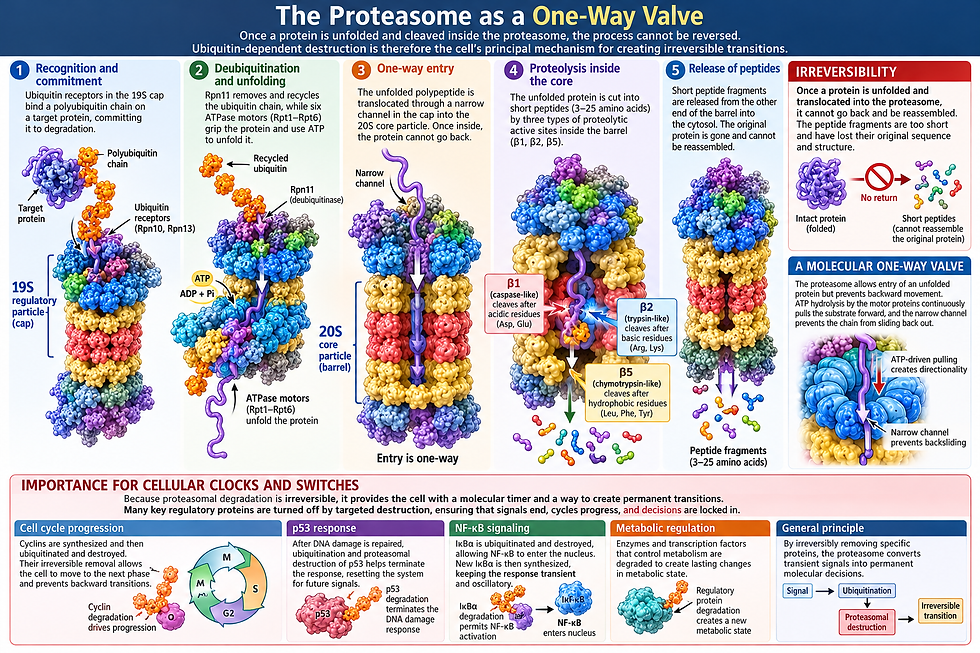
The most famous destination for ubiquitinated proteins is the proteasome, the cell's large protein-destruction machine.
A protein carrying an appropriate ubiquitin chain is recognized at the proteasome. The ubiquitin is generally removed and recycled. ATP-powered molecular motors then grab an accessible region of the target protein, unfold it, and pull the protein into an internal chamber where it is cut into small pieces. This is much more than garbage disposal.
Destroying a regulatory protein can alter cellular behavior within minutes. A protein that stimulates cell division can disappear. An inhibitor can disappear. A signaling molecule can disappear. A protein protecting the cell from death can disappear.
Unlike adding or removing many small chemical tags, protein destruction is irreversible. Once a protein has been unfolded and cut apart, the cell cannot simply restore it by removing a tag. It must make a new protein.
The proteasome therefore converts a reversible molecular message into a one-way biological decision.
Ubiquitin Among the Cell's Other Tags
Ubiquitin is only one of many chemical marks placed on proteins. Cells also use phosphate, acetyl, methyl, SUMO, NEDD8, ADP-ribose, and other tags.
These systems are not independent.
One important interaction is simple competition. A particular lysine on a protein can generally hold only one modification at a time. If that position is acetylated, ubiquitin cannot occupy the same place. If ubiquitin occupies it, another competing mark cannot.
The p53 protein provides a striking example. Several lysines near one end of p53 can receive ubiquitin, acetyl, methyl, or other tags. Acetylation can protect and activate p53, while ubiquitination can help send p53 toward destruction. The fate of the protein therefore depends partly on which tag wins the competition.
The tags can also act sequentially. A small phosphate may create a recognition site. Ubiquitin then follows. In this recurring pattern, a small tag reports a condition while a large protein tag commits the system to an action.
One tag can even be read in order to write another. This occurs in DNA repair, gene regulation, and other pathways. The cell can therefore require several independent molecular conditions before proceeding.
The writers themselves can also be tagged. The enzymes placing ubiquitin are regulated by phosphorylation, ubiquitin-like tags, and other modifications.
The tagging system is both author and subject of its own language.

DNA Repair: Several Tags Must Agree
The nucleus provides some of the clearest examples of this combinatorial logic.
When DNA is damaged, the cell does not simply attach ubiquitin and declare “repair.” It builds a molecular environment around the damaged site.
One tag attracts a reader. That reader helps recruit another writer. A second tag is deposited. Additional repair proteins recognize combinations of marks. The modified region around the damaged DNA expands, creating a temporary repair center.
Different combinations can favor different ways of repairing the DNA.
Ubiquitin can therefore help organize repair rather than destroy anything.
This demonstrates why describing ubiquitin only as a destruction tag is so misleading. In the nucleus it frequently behaves more like construction scaffolding, temporarily organizing proteins around a problem.
The same principle occurs during DNA replication. When the replication machinery encounters damaged DNA, modification of a key replication protein can help determine whether the cell uses a quick damage-bypass mechanism or switches to a more accurate alternative.
A single molecular site can therefore become a decision point among competing strategies.

Time, Clocks, and Molecular Memory
Because ubiquitin controls how long proteins survive, it becomes part of cellular timing.
Cell division is an example. The cell must perform major events in the correct order. Chromosomes must be copied before they are separated, and they must be properly attached to the division machinery before separation begins. At critical points, large ubiquitin-writing complexes mark specific regulatory proteins for destruction. Their disappearance allows the cell to move into the next stage.
Because destruction is irreversible, ubiquitin gives the cell cycle direction. It acts like a ratchet that prevents the cell from casually slipping backward.
The same principle appears in the daily biological clock. The timing of the circadian system depends partly on how rapidly important clock proteins are marked and destroyed.
It also appears in p53. After DNA damage, p53 can rise and fall in pulses because production and activation are opposed by delayed ubiquitin-dependent destruction.
NF-κB uses a related feedback system to generate inflammatory pulses and oscillations.
Ubiquitin is deeply involved in biological time. By controlling molecular lifetimes, it helps transform chemistry into sequences, pulses, cycles, and irreversible transitions.

Deciding the Fate of Damaged Mitochondria
The cell must decide whether a mitochondrion is too damaged to keep.
Healthy mitochondria maintain an electrical difference across their membrane. When a mitochondrion becomes seriously damaged and loses this state, a sensor protein called PINK1 accumulates on its surface.
PINK1 modifies ubiquitin and activates a ubiquitin-writing enzyme called Parkin. Parkin begins attaching ubiquitin to proteins on that particular mitochondrion.
PINK1 then modifies the newly attached ubiquitin. This recruits and activates still more Parkin, which places still more ubiquitin on the damaged mitochondrion.
A positive-feedback loop develops. Readers recognize the growing ubiquitin signal and recruit the cell's recycling machinery. Eventually the damaged mitochondrion is enclosed and delivered to a lysosome for destruction.
No single molecule performed the entire decision. Electrical failure changed PINK1. PINK1 changed ubiquitin and Parkin. Parkin increased ubiquitination. More ubiquitin recruited more readers. The readers brought in the recycling machinery.
A gradual loss of mitochondrial function was converted into a commitment to remove the entire organelle.
The decision emerged from the interactions. Just as the actions of the Hep D Virus RNA and its one protein. Just as the dances of mTOR, AMPK, and p53 and NF-kB.

Sensing Oxygen, Stress, and the Outside World
Ubiquitin helps convert environmental conditions into changes in protein abundance.
Oxygen sensing is a classic example. Under normal oxygen conditions, an oxygen-dependent reaction modifies a protein that controls the response to low oxygen. The modification allows a ubiquitin ligase to recognize the protein and destroy it.
When oxygen becomes scarce, the modification slows. The ligase no longer recognizes the target efficiently. The protein survives, accumulates, and activates genes that help the body adapt to low oxygen.
Ubiquitin did not detect oxygen. One molecular system detected the condition, another modified the target, another recognized the modification, ubiquitin was attached, and the proteasome interpreted the ubiquitin message.
Similar arrangements allow cells to respond to oxidative stress, iron availability, DNA damage, abnormal growth signals, and other conditions.
The environment is translated into molecular marks, and those marks are translated into protein lifetimes.

Ubiquitin and the Cell's Major Regulatory Hubs
Ubiquitin and AMPK, mTOR, p53, and NF-κB regulate one another in multiple directions.
AMPK reads the cell's energetic state, particularly the balance among AMP, ADP, and ATP. mTOR helps determine whether nutrients and resources are sufficient for growth. p53 integrates information about DNA damage and many other stresses. NF-κB integrates information about infection, inflammation, damage, and immune activity.
Ubiquitin intersects with all of them.
These major hubs can alter the enzymes that write or remove ubiquitin. At the same time, ubiquitin determines the lifetimes, locations, and interactions of many components within these regulatory systems.
Adenosine provides an additional connection among them. AMPK directly reads adenosine nucleotides. mTOR is connected to metabolic and biosynthetic supplies involving adenosine chemistry. p53 is regulated by tags whose placement and removal depend heavily on adenosine-containing carriers. NF-κB is activated through ATP-dependent tagging reactions and also responds indirectly to extracellular ATP and adenosine during inflammation.
The major hubs are not isolated command centers. They are interacting information-processing systems connected through metabolism, chemical tags, protein turnover, location, and time.

Ubiquitin in Inflammation and NF-κB
NF-κB demonstrates especially clearly that ubiquitin can mean opposite things depending on its form.
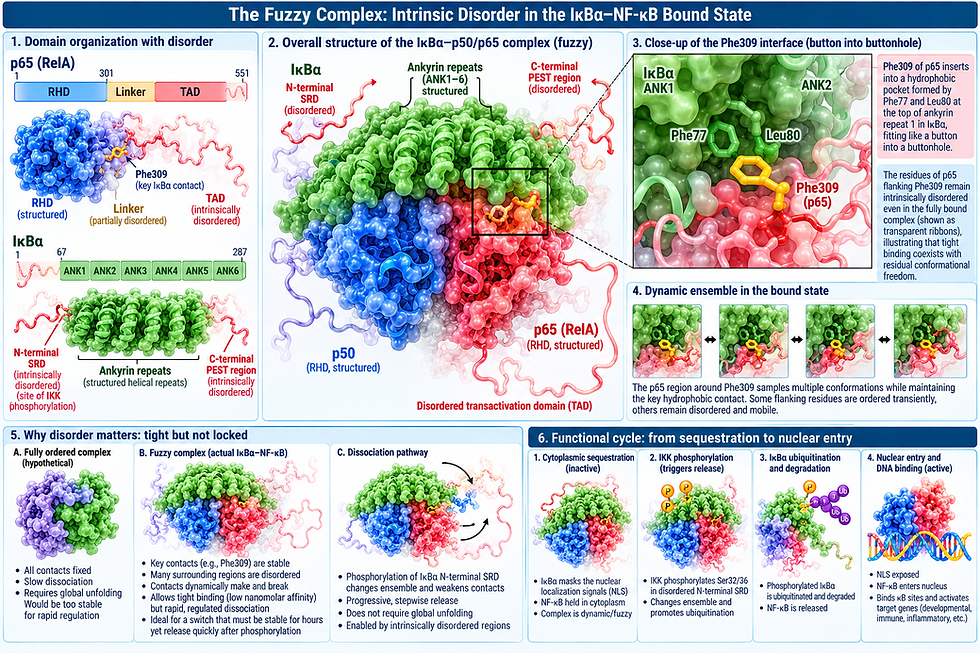
NF-κB is normally restrained by an inhibitory protein. When an inflammatory signal arrives, that inhibitor is first phosphorylated and then ubiquitinated. The proteasome destroys it, freeing NF-κB to enter the nucleus and activate genes. Here ubiquitin means destruction.
But other ubiquitin chains in the same general pathway are not destruction signals. They serve as scaffolds on which signaling molecules assemble. Extended K63 and M1 chains help organize the molecular machinery that transmits inflammatory information.
Later, enzymes that remove ubiquitin help dismantle these structures and shut the pathway down.
Thus ubiquitin participates in turning inflammation on, propagating it, shaping its duration, and helping turn it off.

Movement, Recycling, and Cellular Cleanup
Ubiquitin repeatedly participates in another fundamental cellular question: should something remain where it is, be moved, be repaired, be recycled, or be destroyed?
When a receptor on the cell surface has completed its signaling job, ubiquitin can help direct it inward into the cell. From there, the receptor can be recycled back to the surface or sent for destruction.
When proteins fail to fold properly in the endoplasmic reticulum, ubiquitin can mark them for extraction and destruction.
When proteins aggregate, ubiquitin can recruit selective recycling systems.
When DNA is damaged, ubiquitin can help assemble repair machinery instead of causing destruction.
When a mitochondrion fails, ubiquitin can help remove the entire organelle.
The same molecular word participates in radically different sentences.

When Viruses and Other Pathogens Hijack the Language
One of the strongest demonstrations of the importance of the ubiquitin system is that pathogens have repeatedly evolved ways to manipulate it.
Some viruses recruit the cell's ubiquitin machinery to destroy proteins that would otherwise defend the cell. Certain cancer-causing viruses redirect ubiquitin enzymes toward p53, eliminating an important cellular defense against abnormal growth. Other viruses redirect the machinery against antiviral proteins or immune receptors.
Some bacteria have evolved even more unusual methods, including enzymes that attach ubiquitin through mechanisms different from the normal human pathway.
Pathogens therefore do not need to invent an entirely new cellular control system. They can change the meaning of the existing one by changing who gets tagged.
Failures of the normal system also contribute to human disease. Mutations affecting ubiquitin recognition or processing are associated with cancers, neurological diseases, developmental disorders, and abnormal responses to stress.
A distributed system can fail at many different points because each node reads a different piece of information.

Ubiquitin Can Tag More Than Proteins
For many years ubiquitination was described primarily as the attachment of ubiquitin to lysine amino acids on proteins. Ubiquitin can sometimes be attached to other amino acids through different chemical bonds. Also, cells can place ubiquitin on certain non-protein structures.
One important example occurs when bacteria invade the interior of a human cell. A large cellular enzyme can place ubiquitin directly on part of the bacterial surface. Other ubiquitin machinery then adds additional chains, creating a coat that attracts cellular recycling and defense systems.
The bacterium itself has effectively become a ubiquitinated target.
This discovery expands the conceptual range of the ubiquitin system. Its fundamental task may not be limited to deciding what to do with proteins. It can help the cell label biological objects more generally.

How the Ubiquitin System Evolved
The modern ubiquitin system is a eukaryotic innovation, but parts of its chemistry are far older.
Bacteria contain small proteins with a similar basic fold and enzymes that use ATP to activate them through related chemistry. Archaea also possess small protein modifiers. Some bacteria independently evolved protein-tagging systems that direct proteins toward their own degradation machinery.
The crucial evolutionary expansion in eukaryotes appears to have occurred largely in recognition.
The central chemistry remained relatively conserved. What multiplied enormously were the molecular components capable of recognizing different targets under different circumstances.
Plants possess huge families of ubiquitin-recognition proteins. Plant hormones can even act as molecular bridges that cause a ubiquitin ligase to recognize a protein it would otherwise ignore.
Biology can preserve a reliable central mechanism while allowing the recognition machinery surrounding it to diversify. New ways of deciding where ubiquitin should go were repeatedly invented.

Medicine Learns to Redirect the System
Modern medicine has begun deliberately exploiting the same principle.
Traditional drugs usually work by binding to a protein and blocking some part of its activity. A newer strategy asks a different question: why merely inhibit a harmful protein if the cell can be persuaded to destroy it?
One approach uses small molecules called molecular glues. A glue changes the contact surface between a ubiquitin ligase and another protein. The ligase suddenly recognizes a target that it would normally ignore. Ubiquitin is added, and the target is destroyed.
Thalidomide and related drugs were eventually discovered to work partly through this principle.
A second strategy uses molecules called PROTACs. These contain one region that binds a disease-related protein and another that binds a ubiquitin ligase. The drug physically brings the two together. The cell then treats the disease protein as a ubiquitin target and destroys it.
The drug does not have to perform the destruction itself. It redirects the cell's existing machinery.
This is a profound shift in pharmacology. Medicine is learning not merely to block molecular activity but to rewrite molecular recognition.
The therapeutic possibilities are potentially enormous because humans possess more than six hundred ubiquitin ligases, while present drug-development strategies exploit only a small fraction of them.

Where Is the Intelligence?.
The information is distributed across recognition, chain construction, readers, erasers, competing chemical tags, metabolism, cellular location, concentrations, feedback loops, and time.
One molecular agent determines whether a target is eligible. Another helps determine what ubiquitin structure is built. The structure changes which readers can bind. Erasers determine how long it lasts. Other tags can block or encourage ubiquitination. Cellular location determines which participants can meet. Metabolism determines which reactions can be supported. Feedback changes what happens next.
The outcome of ubiquitin tags emerges from the interactions among tags, chains, readers, erasers, cell location, metabolism, feedback and more. Just like the flexible, dancing interactions of virus RNA and protein, AMPK, p53, and mTOR the intelligence is distributed in the interactions.

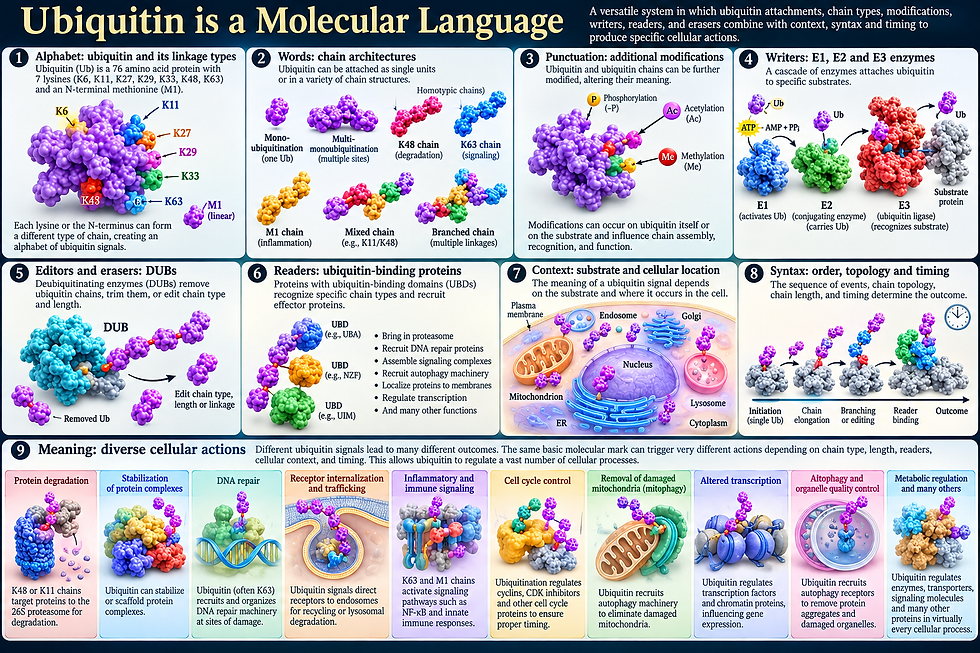
The language analogy is useful. Ubiquitin itself is something like a word.
Chain structures provide part of the vocabulary. The attachment enzymes are writers. The ubiquitin-binding proteins are readers. The deubiquitinating enzymes are editors and erasers. Other chemical tags supply context. Location and timing provide syntax.
And the meaning appears as action.
Destroy this protein. Keep that one. Repair this region of DNA. Move this receptor. Assemble this signaling complex. Stop this inflammatory pathway. Remove this mitochondrion. Allow the cell to divide. Prevent it from dividing.
The word is simple. The conversation is not.
The basic ubiquitin machinery is well established. Ubiquitin is activated through an ATP-dependent process. It passes through a small hierarchy of activating, carrying, and target-recognition enzymes. Different ubiquitin connections form different structures. Proteins read these structures. Other enzymes remove or remodel them. The proteasome recognizes appropriate ubiquitin signals and destroys selected proteins. Ubiquitin has established roles in DNA repair, cell division, inflammation, mitochondrial quality control, protein recycling, and numerous other processes.
It is firmly established that the system interacts extensively with other molecular tags and with the major regulatory networks of the cell.
The ubiquitin system is a language, a society, a distributed intelligence that senses conditions, integrates multiple inputs, creates conditional responses, stores temporary molecular states, uses positive and negative feedback, distinguishes among targets, changes its behavior according to context, and distributes these functions among large numbers of interacting participants.

A Single Word With an Enormous Vocabulary
A tiny protein with a nearly invariant structure participates in thousands of different molecular situations. It can help destroy a protein, build a signaling platform, organize DNA repair, control inflammation, determine molecular lifetimes, regulate cell division, remove damaged mitochondria, direct receptors through the cell, help defend against invading microbes, and coordinate with the major regulatory hubs that monitor energy, nutrients, genome integrity, and immune activity.
Its meaning is supplied by the network around it.
Adenosine provides much of the energetic and chemical foundation, movement and motivation if you will. Recognition enzymes determine where ubiquitin is placed. Chain construction changes its shape. Other tags provide conditions. Readers interpret the resulting structure. Erasers revise it. Cellular geography determines who can encounter whom. Feedback changes subsequent behavior. Time changes the meaning again.
If these processes merely operated independently, the result would be a collection of switches. Instead, they read one another, compete with one another, modify one another, and respond to the changing state of the cell.
Small tags frequently establish conditions. Large protein tags such as ubiquitin can create commitments. Readers translate combinations into actions. Some readers trigger new tags in response. Erasers revise the message. Energy and metabolic carriers connect the entire process to the condition of the cell.
This is why the ubiquitin system is such a powerful example of distributed biological organization. The intelligence does not reside in the word. It resides in the conversation.