
The Dance of Adenosine, AMP, ATP, and RNA
Updated: Jul 26

Adenosine is in perpetual motion. The aromatic adenine ring continually redistributes its electrons, creating changing electrostatic landscapes that influence how it interacts with neighboring molecules. The ribose sugar flexes between slightly different conformations, altering the molecule's three-dimensional geometry. The bond connecting the base to the sugar rotates, allowing adenosine to present different molecular surfaces to enzymes, receptors, and RNA. Around it, layers of water molecules constantly rearrange, forming and breaking hydrogen bonds millions of times each second. Even the surrounding electron cloud continuously shifts in response to nearby atoms and electric fields. Adenosine resembles a tiny molecular dancer, constantly exploring different shapes.
These subtle movements have profound consequences. Every fluctuation changes the geometry of hydrogen bonds, the accessibility of binding sites, and the distribution of electric charge. RNA molecules depend on these tiny motions to fold into ribozymes, ribosomes, and regulatory structures. Proteins recognize not only the chemical composition of adenosine but also these fleeting conformations. In many cases, enzymes bind not to a single rigid structure but to one member of a rapidly changing population of shapes. Biological recognition is a process of selecting from a moving ensemble rather than docking onto a fixed object.
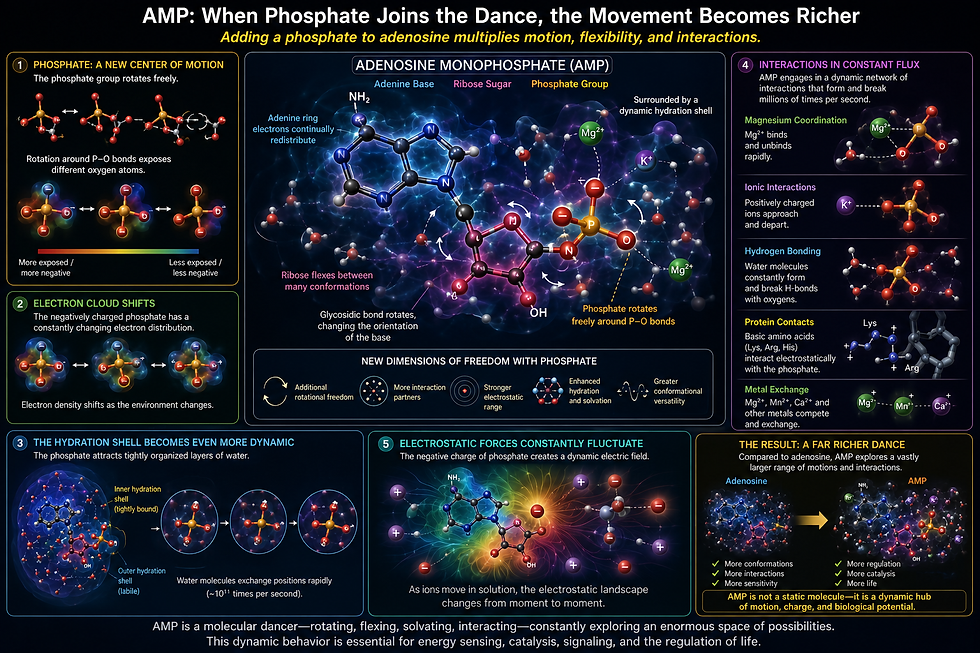
When a phosphate was added creating AMP, the dance became considerably richer. The negatively charged phosphate introduces new dimensions of motion. It rotates freely, continuously changing which oxygen atoms are exposed. Its electron cloud shifts as magnesium ions, water molecules, and positively charged amino acids approach and depart. The hydration shell surrounding AMP becomes even more dynamic because the phosphate attracts tightly organized layers of water that are constantly exchanging with bulk solution. Every moment, electrostatic forces fluctuate as nearby ions move through the crowded cellular environment.
Proteins that detect AMP, such as AMPK recognize precise shapes and electrostatic arrangements generated by its continual molecular dance. The dynamic behavior of the molecule allows it to stabilize specific protein conformations that signal energy shortage, triggering a coordinated cellular response that conserves energy and restores metabolic balance.
ATP elevates this choreography to an entirely new level. Three highly charged phosphate groups repel one another continuously, causing the phosphate tail to flex, bend, and rotate through an enormous range of conformations. Magnesium ions repeatedly bond with the phosphates, subtly reshaping ATP as enzymes prepare it for chemical reactions. Electron density shifts throughout the phosphate chain as chemical reactions approach, while surrounding water molecules reorganize to facilitate phosphate transfer. ATP is therefore not a rigid packet of chemical energy waiting to be broken apart. It is an extraordinarily dynamic molecular machine whose constant fluctuations prepare it for thousands of different biochemical reactions.

Motor proteins reveal the remarkable importance of this dance. Kinesin, dynein, myosin, and countless enzymes that utilize ATP do not simply bind ATP and hydrolyze it. They induce specific distortions in ATP's continuously fluctuating structure. As ATP changes shape, the proteins themselves undergo large conformational transitions that generate mechanical work. Tiny atomic movements within ATP are amplified into nanometer-scale motions that transport chromosomes, separate organelles, contract muscles, and power the movements of living cells. The dance of one small molecule becomes the movement of an entire organism.
RNA is often described as storing information in its nucleotide sequence, but every adenosine within an RNA strand is continuously moving. Each local fluctuation contributes to larger breathing motions of helices, loops, bulges, pseudoknots, and junctions. Entire RNA molecules constantly sample alternative folds, much as intrinsically disordered proteins sample alternative conformations. Function frequently emerges not from one stable structure but from the ability to transition among many closely related structures. The language of RNA is therefore written not only in sequence and shape, but in motion.

Life's information has always been dynamic. Electrons shift, atoms vibrate, bonds rotate, hydration shells reorganize, molecules flex, and larger molecular assemblies respond by changing their own shapes. Every level influences the next, creating an unbroken chain of communication that extends from quantum-scale electron movements to the physiology of entire cells.
The dance of adenosine, AMP, and ATP illustrates one of biology's deepest principles: molecules are not passive objects but active participants in an ongoing molecular conversation. Their continual fluctuations are not random background noise. These dynamic ensembles, allow proteins, RNAs, and entire cellular networks to recognize, interpret, and respond to movement itself. In this sense, life does not merely read molecular structures—it watches their dance.


