
mTOR’s Emergence as the Master Cellular Regulator
Updated: Aug 31
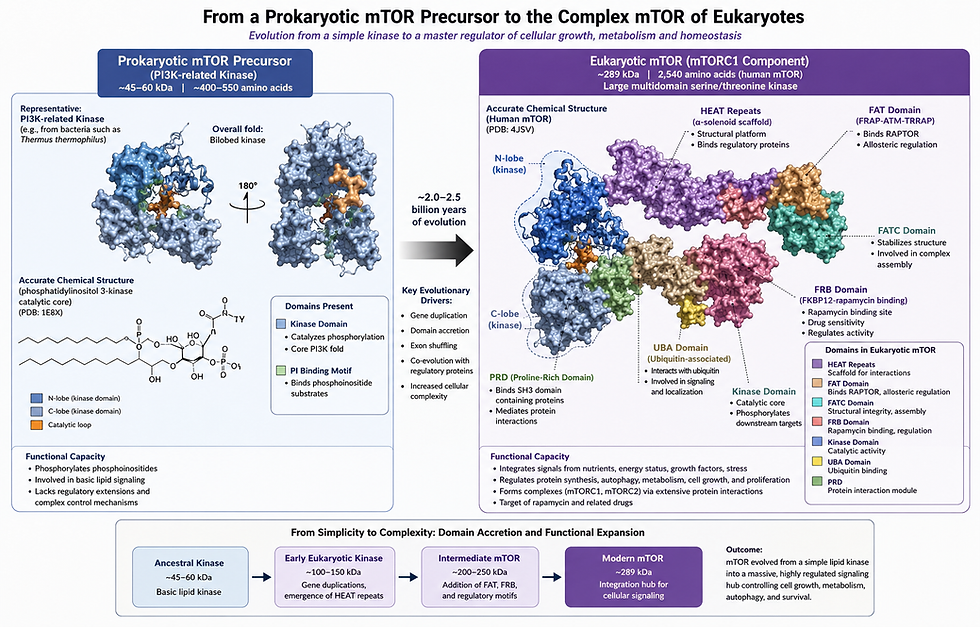
Increasing Intelligence of mTOR:
From a Primitive Survival Kinase to the Master Integrator of Complex Life
The story of mTOR shows that biology builds increasingly intelligent molecules not by inventing entirely new molecules, but by continuously expanding the information-processing abilities of existing ones. Today, mTOR (mechanistic Target of Rapamycin) is near the top of the regulatory hierarchy of virtually every human cell. It decides whether cells should grow or shrink, divide or remain quiescent, synthesize proteins or recycle themselves, store nutrients or burn them, repair damage or commit to death. Yet this extraordinary molecular decision-maker began as something far simpler—a primitive protein kinase whose primary task was merely helping early cells survive fluctuating environmental conditions. Kinase enzymes are one of the largest families of proteins—biological engines that switch proteins and molecules on or off by adding a chemical tag called a phosphate group
More than two billion years ago, before plants and animals existed, ancestral bacteria and archaea constantly faced dramatic changes in nutrient availability, energy production, temperature, oxidation, and osmotic stress. Survival depended on rapidly detecting whether sufficient resources existed to invest energy in growth. Primitive kinases were molecular switches capable of sensing intracellular conditions through subtle changes in shape that altered their ability to interact with other molecules. Before eukaryotes, a precursor of mTOR existed in bacteria and archaea with many of its fundamental components—ATP sensing, adding phosphates to proteins, amino acid metabolism, and sending signals related to the cell’s membrane. This precursor of mTOR did not have an elaborate control center. It began with a simple enzyme that answered one fundamental question: "Is now a good time to grow?"

As the first eukaryotic cells appeared approximately two billion years ago, cellular organization became dramatically more complicated. Cells acquired internal compartments, mitochondria, an endomembrane system, a cytoskeleton, and vastly expanded genomes. Growth decisions could no longer rely solely on nutrient availability. A growing cell now needed to coordinate protein synthesis, membrane production, ribosome assembly, chromosome replication, organelle biogenesis, and cytoskeletal remodeling.
A kinase that once monitored only metabolic conditions gradually became connected to many other different signaling pathways. Rather than functioning as an isolated switch, it became an integration center capable of combining multiple streams of information into a single coordinated decision.
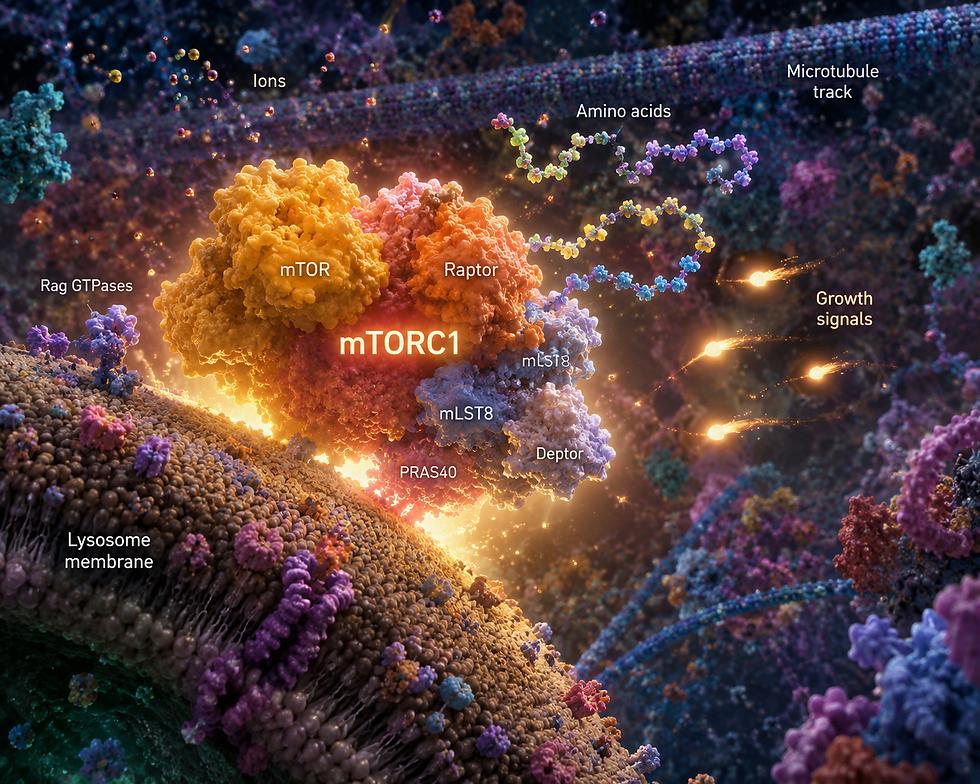
The emergence of lysosomes transformed mTOR's capabilities. Instead of simply responding to nutrients diffusing throughout the cytoplasm, mTOR became physically recruited to the lysosomal membrane, where multiple huge molecular complexes including amino acid transporters, together formed a very sophisticated signaling platform. The lysosome was no longer merely a digestive organelle. Working with the lysosome it became an information hub that continuously measured intracellular nutritional status. mTOR learned to interpret concentrations of amino acids, lipids, nucleotides, and sugars. It monitored these material levels, energy reserves, oxygen availability, and growth factor signals simultaneously before determining whether growth should proceed. The kinase was no longer a simple sensor, but a master conductor of cellular actions.
With multicellular organisms an entirely new level of complexity emerged. Individual cells could no longer optimize only for themselves. Every growth decision now had consequences for neighboring cells and the organism as a whole. mTOR became connected to extracellular communication systems including insulin, cytokines, and numerous developmental signals. Growth was no longer determined simply by nutrient abundance. Instead, each cell had to ask whether the entire organism wanted that tissue to expand, repair itself, differentiate, or remain dormant. mTOR now could integrate both intracellular metabolism and organism-wide physiological priorities.
A remarkable innovation greatly advanced the integration of all this information—the appearance of two distinct molecular assemblies built around the same action protein kinase. Rather than creating two entirely different kinases, mTOR was surrounded with two different sets of regulatory partners, giving rise to mTOR Complex 1 and mTOR Complex 2.
The original kinase molecule had a huge scaffold used to stimulate phosphate reactions. It was built largely from repeated molecular sequences of stacked pairs of alpha helices, dozens of them, in the shape of a coiled slinky stretched into a gentle horseshoe. This is not an efficient design in that it is mostly surface — surface available for other proteins to dock onto. This structure, while not efficient at that time, was prescient in that it could allow many different reactions to be accommodated at the same time. It is this scaffold that allowed the enormous expansion where the same molecular scaffold was recruited into two separate, mutually exclusive protein complexes, each defined by a different partner subunit, each wired to a different set of upstream inputs, and each dedicated to a different category of cellular decision. The two structurally exclusive complexes partitioned the organism's most consequential biological decision, whether to grow or to conserve, into two coordinated but separable subsystems. Each has its own upstream sensing logic and its own repertoire of actions, and the two subsystems are wired into a feedback loop where the two complexes can control each other.

This new addition of multiple molecular clusters to the scaffold dramatically expanded functional diversity while preserving the catalytic core. mTORC1 became specialized for nutrient sensing, ribosome biogenesis, protein synthesis, lipid production, nucleotide synthesis, and inhibition of autophagy. Through interactions with multiple large molecular complexes like Raptor and lysosomal signaling machinery, mTORC1 became the principal regulator of cellular growth and biosynthesis.
The second complex, mTORC2, by incorporating multiple different molecular complexes such as Rictor and distinct accessory proteins, became specialized for sensing membrane-associated signaling and controlling cellular architecture. Rather than focusing primarily on nutrient abundance, mTORC2 regulates actin cytoskeletal organization, membrane dynamics, cell migration, polarity, survival signaling, and activation of a wide range of kinases vital for much of the cell’s important signaling pathways. This division of labor allowed one catalytic enzyme to oversee two complementary aspects of cellular life: the acquisition of biomass through mTORC1 and the organization, movement, and resilience of that biomass through mTORC2.

With nervous systems developed, mTOR acquired even broader responsibilities. Neurons required localized protein synthesis within dendrites and axons, long-term synaptic remodeling, learning, memory formation, and rapid responses to changing patterns of electrical activity. mTOR became intimately linked to calcium signaling, neurotransmitter receptors, synaptic plasticity, neurotrophic factors, and local translation machinery. Rather than regulating only cell-wide growth, mTOR could now control protein synthesis within tiny subcellular compartments only micrometers in size, allowing individual synapses to strengthen or weaken independently during learning. The same ancient kinase that once helped primitive cells survive starvation had become a participant in memory, cognition, and neural adaptation.
Immune systems further expanded mTOR's regulatory repertoire. Immune cells constantly shift between resting surveillance, explosive proliferation, cytokine production, migration, and memory formation. mTOR evolved connections with antigen receptors, inflammatory cytokines, metabolic checkpoints, hypoxia pathways, and innate immune sensors. Different patterns of mTOR activity help determine whether lymphocytes become inflammatory effector cells, long-lived memory cells, or regulatory populations that suppress immune responses. The kinase now could interpret complex physiological contexts involving infection, inflammation, tissue repair, and systemic metabolism.
Most impressive is how mTOR now integrates all the pathways it controls. Amino acids, glucose availability, ATP concentration, AMP levels through AMPK, oxygen tension, DNA damage, oxidative stress, mitochondrial performance, mechanical forces, growth factors, hormones, extracellular matrix stiffness, circadian rhythms, neuronal activity, and immune signals all converge upon this single regulatory network. Rather than responding to any one input in isolation, mTOR weighs all available information before coordinating an appropriate cellular response. Its behavior resembles a sophisticated decision-making system that computes probabilities rather than following rigid linear instructions.
This remarkable expansion of function occurred not by replacing the original kinase but by continuously adding new layers of regulation—new protein domains, new binding partners, additional phosphorylation sites. Each innovation added another dimension of information processing while preserving the underlying catalytic machinery. Scaffold proteins organized signaling complexes. Feedback loops stabilized outputs. Negative regulators prevented excessive activation. Spatial localization restricted signaling to particular organelles. Phase-separated condensates concentrated signaling molecules where needed.

Modern mTOR no longer simply answers whether a cell should grow. It asks whether sufficient nutrients are available, whether energy reserves are adequate, whether oxygen is sufficient, whether DNA is intact, whether neighboring cells approve, whether hormones support growth, whether infection is present, whether mechanical forces favor expansion, whether the organism is developing or aging, and whether resources should instead be devoted to repair or recycling.
Starting as a molecule that sensed only one variable it became an integrative system capable of evaluating dozens of independent variables simultaneously and making decisions weighing all of the information at once. Each new layer of regulation increased the molecule's capacity to process information, coordinate competing priorities, and generate adaptive behavior. Each demonstrated a new level of molecular and cellular intelligence. mTOR became more important by acquiring new binding partners, new regulatory logic, and two entirely distinct multiprotein identities, each with its own decision-making architecture.
How can a molecule acquire the abilities to understand more and more vital factors, to make more and more complicated decisions based on these factors, and then integrate all of them at the same time to make global decisions? How can this be done without the enormously complex molecular cluster having access to a molecular mind?


