More p53 Intelligence Discovered - Intermediate Decision States Between Cell Life and Death

For many years, p53 was viewed as the cell's principal regulator of apoptosis. Its function appeared relatively straightforward. DNA damage activated p53, p53 stopped the cell cycle while repair occurred, and if the damage proved too severe, p53 activated genes such as BAX, PUMA, and NOXA that caused the mitochondria to release cytochrome c and initiate apoptotic cell death. This picture established p53 as the "guardian of the genome," but it also suggested that its decision-making repertoire was relatively limited: repair the cell or destroy it.
Over the past two decades, that view has changed dramatically. Dramatic research advances show that cells possess not two mechanisms of death—necrosis and apoptosis—but more than twenty distinct mechanisms of cellular death, with additional pathways continuing to be discovered. These death mechanisms include ferroptosis, pyroptosis, necroptosis, cuproptosis, disulfidptosis, alkaliptosis, ETosis, parthanatos, paraptosis, entotic cell death, autophagy-dependent cell death, PANoptosis, and others.
Even more surprising, some cells can delay their own death to complete important tasks, while others can reverse the dying process entirely through a phenomenon known as anastasis. It is defined as cells that manage to reverse the process of programmed cell death (apoptosis) and recover. Cell death is no longer viewed as a simple endpoint but as a diverse collection of regulated biological programs with important consequences for development, immunity, inflammation, and disease.

Expanded View of p53 and Cell Death
This expansion in our understanding of cell death has transformed our understanding of p53. Rather than functioning as the controller of one death pathway, p53 increasingly appears to act as a master decision-making system that helps determine which of the cell's many available programs should be activated under particular circumstances. Recent reviews conclude that p53 regulates not only apoptosis but also numerous forms of non-apoptotic regulated cell death, including ferroptosis, necroptosis, pyroptosis, autophagy-dependent cell death, entotic cell death, parthanatos, paraptosis, and probably cuproptosis, disulfidptosis, and PANoptosis in specific contexts.
The best understood of the newer pathways is ferroptosis. Unlike apoptosis, ferroptosis is not driven by caspase enzymes or mitochondrial cytochrome c release. Instead, it results from uncontrolled oxidation of membrane lipids in the presence of iron. As lipid peroxides accumulate, cellular membranes—including those of the endoplasmic reticulum and other organelles—undergo catastrophic destruction until the cell falls apart. Cancer cells, because of their unusually active metabolism and high production of reactive oxygen species, are often particularly susceptible to ferroptosis, making this pathway one of the most promising new strategies for cancer therapy.
p53 plays an important but remarkably nuanced role in ferroptosis. Rather than acting as a simple on-off switch, it regulates cellular metabolism, antioxidant defenses, glutathione production, iron handling, and lipid oxidation. Through targets such as SLC7A11, SAT1, and GLS2, p53 can increase susceptibility to ferroptosis by permitting lipid peroxidation to proceed. Under other physiological conditions, however, p53 can delay or suppress ferroptosis, illustrating that its purpose is not to maximize cell death but to choose the most appropriate outcome for the cell and the organism.
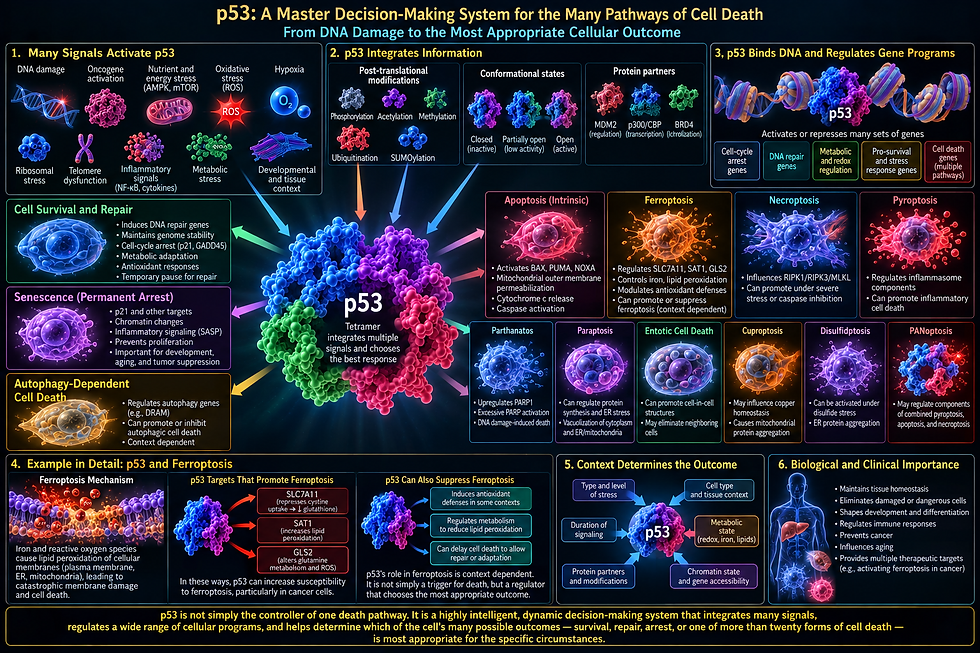
Another important pathway is pyroptosis, a highly inflammatory form of cell death that differs dramatically from apoptosis. Instead of quietly dismantling itself, the cell develops pores in its plasma membrane, releases inflammatory cytokines and danger signals, and alerts neighboring immune cells that infection or tissue injury has occurred. This pathway is especially important during bacterial and viral infection. Pyroptosis as one of the principal regulated inflammatory death programs that has broadened our understanding of immunity.
p53 appears to influence pyroptosis less directly than apoptosis or ferroptosis. It regulates the expression of several inflammasome components and pyroptotic mediators, including NLRP3, caspase-1, and gasdermin family proteins, thereby priming cells to undergo pyroptosis when appropriate secondary signals arrive. Rather than stimulating pyroptosis itself, p53 often prepares the molecular environment that allows inflammatory cell death to occur if infection or severe stress demands it.
A related inflammatory pathway is necroptosis. Unlike apoptosis, which packages cellular contents into membrane-bound fragments, necroptosis culminates in membrane rupture and release of intracellular material that strongly stimulates inflammation. Necroptosis functions as an important defense against pathogens that have evolved ways to block apoptosis. Infection itself may have driven the evolution of multiple overlapping death programs because viruses frequently evolve mechanisms that inhibit one pathway, forcing cells to activate another.
Here again p53 functions primarily as an upstream coordinator rather than as the direct producer of the effect. It influences necroptosis through transcriptional regulation of inflammatory pathways, mitochondrial reactive oxygen species, innate immune signaling, and stress-responsive proteins that converge on the RIPK1-RIPK3-MLKL signaling cascade. p53 becomes part of a broader cellular defense network in which different death mechanisms provide alternative strategies when one pathway has been blocked by pathogens or mutations.

The newer death mechanisms continue to expand this pattern.
Cuproptosis links cell death to toxic accumulation of copper and mitochondrial metabolism.
Disulfidptosis arises from catastrophic collapse of the actin cytoskeleton under conditions of abnormal disulfide stress.
Parthanatos results from excessive activation of PARP enzymes following overwhelming DNA damage.
Paraptosis involves extensive swelling of intracellular organelles rather than apoptotic fragmentation.
Entotic cell death occurs when one living cell engulfs another.
Autophagy-dependent cell death represents an extreme form of the normally protective recycling process.
Evidence continues to accumulate that p53 either directly regulates or strongly influences many of these pathways through its control of metabolism, oxidative stress, mitochondrial physiology, lysosomal function, inflammation, and transcriptional programs, although the strength of evidence varies among pathways.

Cell Death is Reversible
Perhaps the most surprising discovery is that cell death itself is no longer viewed as irreversible. Cells sometimes delay their own destruction long enough to complete important biological tasks. Gut epithelial cells, for example, temporarily repair membrane damage so they can exit the intestinal lining cleanly before dying. Immune cells complete antimicrobial functions during their final moments, releasing cytokines or extracellular DNA traps while sacrificing themselves to protect surrounding tissue. Researchers have even discovered anastasis, in which cells that have already entered apoptosis can occasionally recover after the death stimulus disappears. These findings suggest that cells possess intermediate decision states between life and death rather than crossing an immediate point of no return.
Anastasis, understood this way, is not simply the absence of a death signal but the presence of a distinct recovery signal capable of overturning a p53 verdict that was already in progress, provided the cell has not yet crossed whatever threshold, likely tied to irreversible mitochondrial disruption, beyond which no reversal is possible. That p53 can apparently be appealed and overruled by a separate cellular program adds a genuinely new dimension to what its role in the cell's decision architecture actually is.

New Form of Distributed Intelligence
These discoveries expand the role of p53. Instead of functioning as a simple trigger for apoptosis, p53 increasingly appears to evaluate a far richer set of possibilities. Modern p53 continuously integrates information about DNA integrity, oncogene activation, oxidative stress, mitochondrial function, ribosomal stress, nutrient availability, oxygen tension, energy status through AMPK, biosynthetic status through mTOR, inflammatory signals, chromatin organization, and the temporal history of previous stress responses. Rather than asking whether a cell should simply live or die, p53 appears to ask a much more sophisticated question: Which biological program best preserves the integrity of the organism under these particular conditions?
The available responses now include transient cell-cycle arrest, DNA repair, metabolic adaptation, antioxidant defense, autophagy, senescence, apoptosis, ferroptosis, modulation of inflammatory death pathways, and perhaps additional specialized programs that remain to be fully understood. The evolution of these additional death mechanisms therefore did not merely add new methods of cellular destruction. It greatly expanded the computational landscape through which p53 operates. Instead of regulating one endpoint, p53 now appears to supervise an increasingly diverse repertoire of carefully regulated cellular fates.
Seen from this perspective, the evolution of regulated cell death and the evolution of p53 have proceeded together. As multicellular organisms evolved increasingly specialized tissues, more complex immune systems, and more sophisticated defenses against infection and cancer, cells acquired an expanding library of death programs. In parallel, p53 emerged from being a relatively simple DNA damage sensor into a master information-processing system capable of integrating an extraordinary range of molecular signals and selecting among an equally extraordinary range of cellular responses. Modern p53 therefore serves not simply as the guardian of the genome, but as one of the cell's principal coordinators of survival, adaptation, repair, and the many distinct pathways through which a damaged cell can ultimately come to an end.
The emerging picture of p53 is a recurring adjudicator that gets summoned into structurally different situations and, once there, applies different logic depending on the case. In the apoptotic situation it behaves as a classical transcriptional producer, building a case gene by gene against a damaged cell. In the ferroptotic situation it behaves as a metabolic gatekeeper, withdrawing a single transporter's license and letting an entirely separate chemistry, iron-catalyzed lipid peroxidation, do the actual work of destruction. In the autophagic situation it behaves almost as two different judges depending on where in the building it happens to be standing, nucleus or cytoplasm, ruling in opposite directions from the same evidence. And in the anastatic situation, it has its own prior ruling overturned by a separate recovery apparatus the cell can invoke.
p53 is not confined to the single pathway it was discovered through. It is a recurring node across a structurally diverse set of death and survival programs, wired into each one through different molecular logic, and reversible in at least one of them. Along with the hundreds of variables that it is weighing, already described in the previous post, this is a new form of distributed cellular intelligence.