
Molecular Mind in Cellular Motors 7: The Society of Cell Motors and Tracks

Updated: Sep 7

When most people imagine a living cell, they picture a microscopic bag of organic materials. In fact, as described in prior posts, a cell is a vast, organized society whose members constantly communicate, cooperate, negotiate, compete, and adapt to changing conditions. At the center of this society lies a remarkable transportation system: an immense network of molecular tracks, scaffolds, motors, signaling complexes, organelles, and regulatory molecules that continuously exchange information while moving cargo everywhere throughout the cell.
This is no ordinary transportation service. Here, roads (microtubule tracks) continuously grow, shrink, branch, merge, and reorganize. They respond to stress, nutrient availability, developmental signals, and environmental conditions. Vehicles (molecular motors) can communicate with the roads, cargo adaptors, traffic signals, destinations, and surrounding vehicles. The buildings themselves (molecular scaffolding) can move to new locations when needed. Entire neighborhoods instantly reorganize in response to changing demands. The cargo carried by the motors talks to the roads, vehicles, and the building. Tens of thousands of molecular motors are walking, pulling, negotiating, and building, and every movement is simultaneously a transfer of matter and a transfer of information. A motor stepping like a human along a microtubule is continuously interpreting structural information embedded within the track. Microtubules communicate through chemical tags that are placed and removed by an army of enzymes. The tracks themselves are active participants in cellular decision-making.
There are many different overlapping signals. A large number of enzymes, such as kinases and phosphatases, constantly change tag signals by writing and erasing markers on motors, adaptors, and cargo to shift transport direction in real time. Regulatory molecules can activate one motor while suppressing another. Mechanical tension itself can influence motor behavior. Local calcium elevation can stop kinesin, activate dynein, and redirect mitochondria within milliseconds—the cell's fastest known routing signal. Every piece of cargo attached to a motor carries a destination address. Signal molecules on the membranes of vesicles and organelles are small enzymes that function as molecular identity tags. Each identity tag recruits a specific set of adaptor proteins that connect that organelle to the correct motor.
Specific lipid phosphoinositide molecules on the membranes of vesicles and organelles produce another type of signal. Examples include phosphatidylinositol with one phosphate tag at a particular location directing cargo to the lysosome, while phosphatidylinositol with two phosphate tags on that location sending it to the Golgi body. These codes are written and erased continuously by kinase and phosphatase enzymes in response to the cell’s needs.
The large number of different adaptor complexes that send and receive signals are important decision makers. They are involved in choosing the correct motors and contribute to determination of cargo destinations, as well as helping multiple motors determine how they cooperate when working together on a cargo.

The tug-of-war
The cytoplasm is extraordinarily crowded—dense with proteins, RNA, ribosomes, organelles, and the vast cytoskeleton itself. Motors constantly encounter obstacles, but can sidestep to an adjacent track or stay on the same microtubule by circumnavigating the obstacle. If a single motor cannot generate enough force to move its cargo, it can recruit additional motors from the surrounding cytoplasm and combine their forces.
Many cargoes, if not most, use multiple walking motors simultaneously, each potentially pushing or pulling in different directions. The cargo often undergoes seemingly chaotic movements, moving forward, backward, pausing, and changing direction. This process is, in fact, a precision steering mechanism that probes the environment for signals as it moves back and forth in different directions. These movements allow cargoes to explore the cellular environment and respond dynamically to changing conditions.
Organelles are active participants in the signaling to motors and tracks. A vast amount of signaling occurs among organelles, such as mitochondria, lysosomes, the Golgi body, and the endoplasmic reticulum. They communicate extensively with each other and with microtubules and motors. Lysosomes combined with mTOR function as signaling hubs, which regulates the cell’s inventory of all molecules needed to build any new structures, including new microtubule tracks. Organelles exchange lipids, calcium ions, metabolites, and signaling molecules with each other when they are in contact.

The Role of Water
Water surrounds every motor, track, membrane, and organelle. All molecules are enveloped by dynamic hydration layers. Hydrogen-bond networks constantly rearrange around molecular surfaces. These hydration structures influence folding, flexibility, binding interactions, enzymatic reactions, and mechanical behavior.
Every interaction involving kinesin, dynein, tubulin, mTOR, RNA, DNA, membranes, and signaling proteins occurs within this structured aqueous environment. The cell's communication network includes not only molecules, but also the dynamic water networks surrounding them.
Condensates Think and Act as Adaptive Hubs
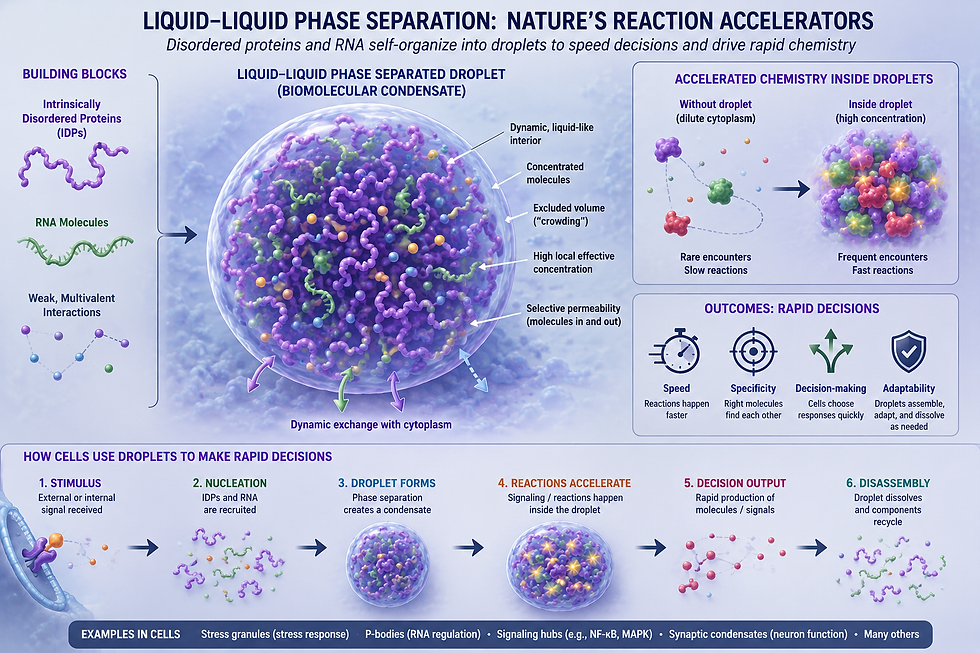
One of the most transformative discoveries in cell biology over the past decade has been the existence of biomolecular condensates—membrane-less organelles that form when disordered proteins and RNA molecules cluster together so densely that they separate from the surrounding cytoplasm the way oil separates from water. These droplets form without any lipid membrane, sustained purely by the weak, transient bonds of disordered protein regions and RNA interactions.
Condensates are a different kind of transport hub. They concentrate motors, cargo adaptors, and regulatory molecules in one place, dramatically accelerating the cell’s decision-making processes and the reactions that depend on these molecules finding each other. A condensate can selectively include kinesin while excluding dynein—tipping the direction of transport for any cargo that passes through it. It can dissolve and reform within seconds in response to a phosphorylation event. Its composition—and therefore its behavior—changes continuously with the cell's needs.
Biophotons, electromagnetic fields, and the hidden signaling layer of living systems
Cellular chemical signaling is part of a vast distributed communication network. Motors communicate with tracks. Tracks communicate with signaling pathways. Organelles communicate with one another and all parts of the transport network. Adaptors communicate and integrate information. Surface enzymes on vesicles provide identity. Enzymes constantly produce and eliminate signal tags. Water shapes all these interactions. However, all these factors are not nearly enough to understand how this vast scaffolding system with tens of thousands of molecular motors adapts almost instantly to global decisions of the cell.
When an immune cell rapidly chases a bacterium through tissue, it is changing shape in thousands of ways simultaneously and instantly. When a human thought triggers neuroplasticity and learning, scaffolds and motors instantly organize and build entirely new dendrites to produce new neuronal synapses. The chemical communication network is just not fast enough to keep up with these changes.
The frontier of biological science points to a deeper substrate. At the most fundamental level, every chemical bond and molecular interaction is electromagnetic––the flex of a motor, the binding of an adapter, the structural shift of a tubulin track. Every motor step results from changing electromagnetic relationships among atoms.
The future of our understanding of cell signaling likely lies in decoding the electromagnetic and biophotonic phenomenon already seen to be inherent in all living systems—microtubules as possible optical waveguides and biophotons coming from mitochondria. These are cellular signaling at the speed of light.
Understanding cell communication remains one of the greatest scientific adventures of our time. It is vital to understand how mind throughout nature flows through cellular molecules.


