
A Communication System for All Cells

Updated: Sep 6

In 1972, a British pharmacologist named Geoffrey Burnstock published a paper proposing that ATP is released from nerve terminals and acts as a neurotransmitter. The scientific establishment's response was a dismissal. The objections were that as the universal energy currency of all living cells, ATP was too ubiquitous to serve as a signal among neurons––it was everywhere, inside everything.
That skepticism delayed a medical revolution by two decades. Burnstock continued working, refining, and accumulating evidence through the 1970s and 1980s largely without institutional support. He formalized the concept of "purinergic signaling" and began mapping a receptor classification system. He described two broad families: P1 receptors that respond to adenosine, and P2 receptors that respond to ATP and ADP. The field slowly, grudgingly began to take notice.
Key timeline
1929 - ATP discovered. Considered purely intracellular.
1972 - Burnstock proposes ATP as extracellular neurotransmitter. Hypothesis widely rejected.
1978 - P1 and P2 receptor families formally proposed by Burnstock.
1994 - First P2X receptors cloned, providing molecular proof of concept.
1999 - P2Y receptor family fully characterized. The field becomes legitimate.
2000s - Role of ATP in glial signaling, neuroinflammation, and immune function established.
2010s - Purinergic targets enter clinical trials for pain, cancer, neurodegenerative disease.
The molecular proof of Burnstock’s thesis came in the early 1990s, when the P2X and P2Y receptor subtypes (see end of post for definitions) were cloned and sequenced. This was not merely confirmatory—it opened the floodgates of research in many directions. The research results were staggering in their breadth. ATP was not just inside every cell, but in fact, is also outside every cell, being used as a signaling system. ATP/purinergic receptors were found to be everywhere in the body, used by every type of cell. The implications of this type of universal signaling in every type of cell are just now being considered. There are clearly many ways that groups of cells throughout the body, other than brain cells and immune cells, are sending messages, and we know very little about the details.
What really makes this purinergic system so unique and hard to understand is that all cells in the entire body communicate with these same signals, not just specialized neurons. One way to try to understand the systems’ universality is to consider how a signal from one cell can be rapidly transmitted throughout the entire organism. For many years, it was believed that this process was mediated by cell signaling through the nervous system. We now know this can occur by neuronal signaling, using both traditional neurotransmitters and purinergic signals. Another method of cell communication involves cells secreting signaling molecules into surrounding tissues and the bloodstream, including within small vesicles that transport these molecules. However, this second option is very slow.

However, two other mechanisms for this rapid organism-wide signaling have been found in the purinergic system and there are probably many others. One involves signaling between adjacent cells lining blood vessels. These lining cells form an electrical conduit with rapid electric channels connecting each cell to the next. An ATP signal from one cell can send a message rapidly all along a blood vessel to a distant region, or to all blood vessels, in the organism. Another mechanism of rapid distant signaling is through red blood cells that each contain large amounts of ATP. An ATP signal from one cell lining a blood vessel can trigger an alteration of the diameter of the blood vessel. This narrowing of the blood vessel then triggers one red blood cell to send a signal to a nearby blood cell. Then a cascade of red blood cells begins signaling one to another all along the blood vessel. These actions can send a message throughout the vascular arbor, extending almost everywhere in an organism.
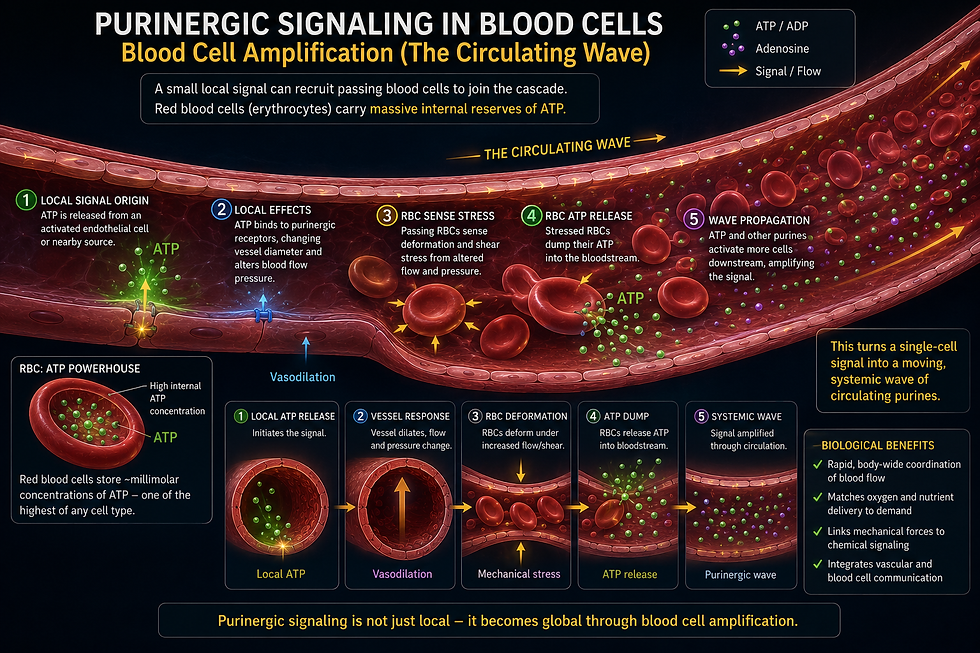
The above purinergic signaling mechanisms are just the tip of the iceberg in understanding how the purinergic system utilizes signals from every single cell in the body. There will undoubtably be many more mechanisms discovered as more is learned about this fundamental signaling encompassing all cells.
One such communicating system could exist in fascia, for example, the largest cellular organ connecting all organs, muscles, nerves, ligaments, and bones in the body. Signals could be sent by the purinergic system through the network of connective tissue cells in fascia, called fibroblasts, producing electrical communication channels. Any node in this fibroblast network could then trigger an immune cell or neuron to tap immune and nervous system signaling throughout the body. Such signaling through fascia has been proposed as a possible mechanism to explain how acupuncture is able to produce actions throughout the body.

To appreciate why the purinergic system is categorically different from the classical neurotransmitter systems, it helps to understand its molecular architecture and how it operates. Where the dopamine system, for example, has five receptor subtypes (D1–D5), the purinergic system has, at a minimum, nineteen functionally characterized receptor subtypes across three receptor families. However, the purinergic system is much more complex than just 19 receptors, because a single ATP signal from a damaged cell does not send a single message. Instead, it triggers a dynamic, shifting chemical clock. At 0 seconds, raw ATP dominates, opening P2X channels to signal acute inflammation or pain. At 5 seconds, enzymes convert it to ADP, switching the signal to focus on things like blood clotting via P2Y receptors. At 30 seconds, the enzymes have fully broken it down into adenosine, which binds to P1 receptors to signal a completely different action: tissue healing, anti-inflammation, and calming. The system is highly fluid, relying on both the 19 separate docking sites and the timing of the enzymes breaking down the messengers.
The purinergic system shows that ATP is not just the energy particle for life. When outside the cell it is an alarm, a damage signal, and a mediator of inflammation. An acute burst of ATP signals danger and inflammation through P2X receptors. As it degrades to adenosine over minutes, the signal becomes anti-inflammatory and neuroprotective. The molecule doesn't just signal—it tells a story over time. There is much more to learn.
For those interested, the 19 known receptors are described here:
P2X ATP Family (7 Subtypes): These are fast-acting, ion channels that open directly when a raw ATP molecule binds to them. They are named P2X1 through P2X7. They mediate rapid depolarization in neurons, fast pain signaling, and microglial activation. P2X4 and P2X7 are major mediators of neuroinflammation. There may be other receptors in this family that are not yet discovered, with different combinations of receptor subtypes.
P2Y Family (8 Subtypes): These are slower, G-protein coupled receptors that respond to a mix of nucleotides (ATP, ADP, UTP, UDP). They are named P2Y1, P2Y2, P2Y4, P2Y6, P2Y11, P2Y12, P2Y13, and P2Y14. They mediate slower modulatory effects across virtually all tissues. The P2Y12 receptors on platelets are the target of the medications clopidogrel and ticagrelor.
P1 Adenosine Family (4 Subtypes): These respond strictly to adenosine (the final breakdown product of ATP). They are G-protein coupled receptors named A1, A2A, A2B, and A3. They respond to adenosine, the terminal breakdown product of ATP. A1 and A2A mediate sleep pressure and arousal regulation (caffeine blocks A2A). A1 is neuroprotective in ischemia. Most cells have these receptors. They regulate cardiac rhythm, vascular tone, immune suppression, and global neuronal excitability.


