
What If Atoms Can Think…

If mind exists throughout all of nature, then how would it manifest in the realm of atoms? Would atoms have desires, goals, and plans? What would be their behaviors and personalities?
Because their electronic structures are so different, each atom in living matter behaves in remarkably consistent, and different, ways. Therefore it is not difficult to describe them as having distinct personalities. These personalities arise from the fundamental laws of quantum mechanics—the arrangement of electrons, the shapes of atomic orbitals, the distribution of electrical charge, and the energetic preferences that govern chemical bonding. Biology is the story of how the personalities of atoms became the behaviors of molecules, cells, organisms, and ecosystems.
Carbon
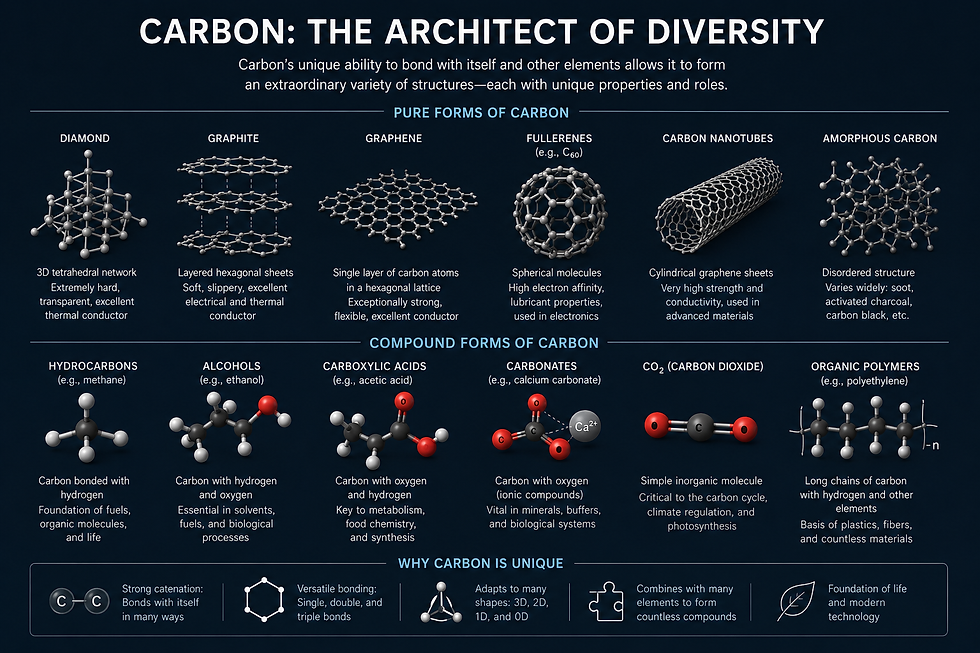
Carbon is the great architect of life. It is restless, enthusiastic, and never stops building. Carbon loves to build anything, but especially long chains. It can form four strong covalent bonds while remaining remarkably stable. It bonds with itself over and over again, producing chains, branches, rings, cages, sheets, tubes, and intricate three-dimensional frameworks. Carbon is very generous and readily bonds with many other molecules forming single, double, and triple bonds maintaining an enormous diversity of structures. This gives nature an unlimited variety of construction material from which to build all life’s molecules.
One of carbon's favorite tricks is closing chains into rings. It forms circular sugars, aromatic rings like benzene and adenosine, and cholesterol—with four fused rings, three six-membered and one five-membered. Carbon’s goals move between the long straight chain, the closed ring, the fused steroid scaffold, the flat aromatic ring — and they move between them according to what the larger molecule needs.
Hydrogen
Hydrogen is a simple, social lightweight that eagerly bonds to share its single electron with countless partners, stabilizing carbon frameworks throughout life. Hydrogen forms hydrogen bonds—weak individually but extremely powerful collectively. These reversible interactions hold together the two strands of DNA, stabilize the folds of proteins, organize RNA into intricate three-dimensional machines, and create the immense interconnected network that makes liquid water unlike any other substance.
Hydrogen is a great traveler, moving easily between molecules as protons. Proton gradients power ATP synthesis, allowing virtually all higher organisms to harvest energy. In this sense, hydrogen behaves less like a builder and more like a communicator, continually connecting molecules, transferring energy, and coordinating countless biochemical reactions.
Oxygen
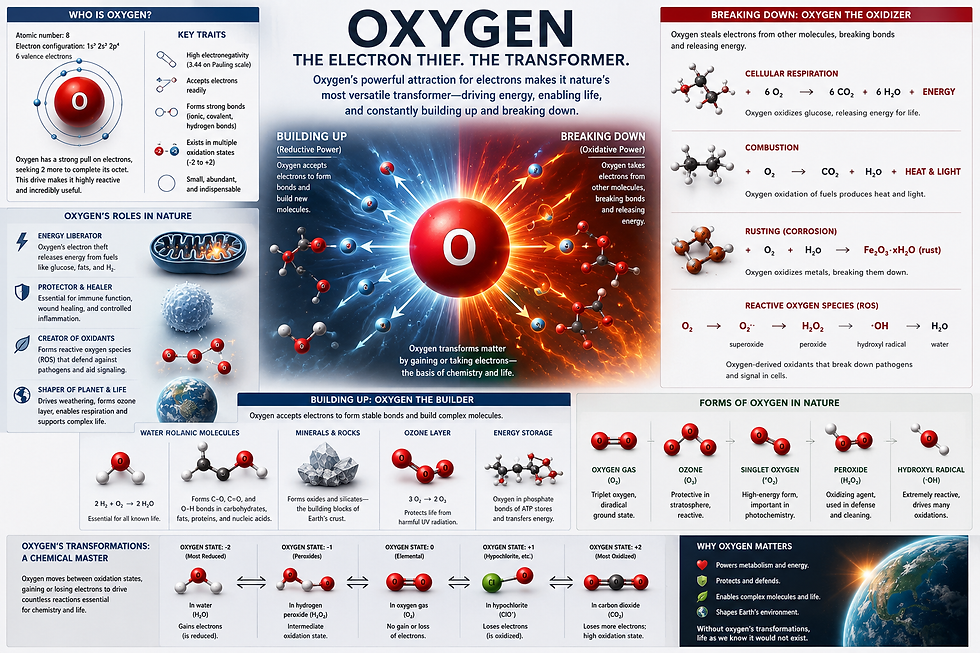
Oxygen is an electron thief, a transformer that builds and destroys. It is a force of nature that architects have learned to harness. It is highly electronegative, powerfully attracting electrons toward itself. It has a hunger for electrons so strong that in nearly every bond it forms, oxygen ends up holding more than its share of electrons. This leaves all of its bonding partners with a small positive charge that other molecules can attack and trigger reactions. Oxygen can be destructive, with oxygen species from respiration used as weapons to destroy invading bacteria.
Oxygen's greed for electrons is so strong that when bonding with carbon, carbon also becomes hungry for electrons. This stimulates carbon reactions such as forming the peptide bond connecting amino acids in proteins. Oxygen doesn't perform these reactions. It sets the electronic stage that makes them possible. Oxygen, also, builds bridges between larger structures, linking nucleotides into the sugar-phosphate backbone of DNA and RNA. It links sugar units together into starch, glycogen, and cellulose and the three phosphate groups into ATP.
Yet oxygen also has a gentler personality. Bound to hydrogen in water, oxygen becomes the center and driving force of nature's most remarkable molecular network. Each water molecule forms constantly shifting hydrogen bonds with its neighbors, organizing all biomolecules with hydration shells.
Nitrogen
Nitrogen is stubborn and diplomatic. Atmospheric nitrogen exists in the atmosphere as two atoms connected by a triple bond, among the strongest in chemistry. It is very difficult to break this bond and therefore, hard to use nitrogen to form other molecules. Once specialized bacteria break this formidable bond, nitrogen is very diplomatic. It is eager to please as both a hydrogen bond donor and a hydrogen bond acceptor at the exact same time. It is in vital positions in adenine, guanine, cytosine, and thymine to form large genetic molecules. It is nitrogen, not the sugar-phosphate backbone, that is doing the actual chemistry of the RNA and DNA base pair.
Phosphorus
Phosphorus stays narrowly focused on two jobs, storing energy and relaying information, and does both with a small set of bonds reused over and over. It is almost always in the form of a phosphate, a phosphorus atom surrounded by four oxygens. Phosphorus can store chemical energy in bonds stable enough to exist for long periods and energetic enough to release useful work when needed. The bonds linking the three phosphate groups of ATP are under considerable electrostatic strain, and releasing that strain provides the energy for most of life’s actions.
Phosphate is, also, a universal signal switch in all of life’s processes. Adding or subtracting a phosphate on a molecule is a universal switch, rapidly turning proteins on or off, altering interactions, and coordinating entire metabolic networks. Kinases add a phosphate and phosphatases takes it off.
Sulfur
Sulfur is a versatile specialist, an engineer, a locksmith, and sensor. Being below oxygen in the periodic table, sulfur is much larger. It can form 2, 4, or 6 covalent bonds and can therefore form bonds unavailable to most other elements. Two sulfur atoms in different molecules form strong disulfide bridges between these molecules. These bridges have many uses, such as two amino acids stabilizing a protein structure. Sulfur, behaves like a structural engineer bolting a building's components together after the architecture is already decided.
Sulfur binds metals easily producing iron-sulfur clusters that perform electron transfer throughout mitochondrial respiration and photosynthesis. Wherever biology encounters a reaction too demanding for oxygen, carbon, or nitrogen alone, sulfur often appears as the molecular problem solver.
The same sulfur atom, in its reduced thiol form, behaves completely differently—not as a fixed staple but as a switch. It cycles between reduced and oxidized states, and this cycling is one of the cell's primary mechanisms for sensing oxidative stress. As part of the free floating glutathione molecule it serves as a mobile sensor of the cell's redox environment.
Also
Selenium takes part in specialized antioxidant enzymes, where its unusual chemistry allows exceptionally rapid detoxification of reactive oxygen species.
Iodine is stabilizing. It is central to thyroid hormones, allowing vertebrates to regulate metabolism across entire organisms.
Metal elements who easily give away electrons.
Sodium eagerly gives away is outer electron and becomes one of biology's principal electrical messengers. Rather than forming complicated molecular structures, sodium excels at movement. Sodium gradients across cell membranes power nutrient transport, nerve impulses, kidney function, and countless transport proteins.
Potassium, although chemically similar, assumes a quieter role. Cells maintain extraordinarily high intracellular potassium concentrations because potassium stabilizes membrane voltage and keeps cells poised for rapid responses. If sodium generates action, potassium preserves readiness.
Calcium is the emergency responder of the cell. Calcium rarely speaks, but when it does, the entire cell listens. Cellular calcium concentrations are very low because even slight increases are powerful signals, triggering muscle contraction, neurotransmitter release, fertilization, immune activation, hormone secretion, and gene regulation. It can coordinate hundreds of downstream molecular events.
Magnesium is the quietest essential atom. Nearly every ATP molecule inside cells is bound to magnesium. It stabilizes DNA, RNA, ribosomes, membranes, and hundreds of enzymes by neutralizing negatively charged phosphate groups. Without magnesium, many of life's most important molecules would repel themselves apart. Magnesium quietly makes countless reactions possible.
Iron is tough, reliable, and essential, but prone to severe "burnout" without the right protection. It shifts between oxidation states, Fe²⁺ and Fe³⁺. This reversible electron transfer makes iron indispensable for respiration, photosynthesis, oxygen transport, and cellular metabolism. Hemoglobin carries oxygen using iron. Iron-sulfur clusters coordinate some of life's oldest metabolic reactions. Because free iron can be destructive, it is treated with extraordinary care, storing and transporting it under tight regulation.
Zinc represents precision rather than power. It is an instrument of molecular craftsmanship. Unlike iron, zinc generally avoids energy chemistry. Instead, it stabilizes protein structures, activates enzymes, and enables proteins to recognize specific DNA sequences. Thousands of transcription factors employ zinc fingers to bind genes with remarkable specificity.
Copper transfers electrons with exquisite efficiency and supports both respiration and antioxidant defense.
Manganese allows plants to split water during photosynthesis.

Taken together, these recurring behaviors create a remarkable division of labor. Carbon provides the architecture. Hydrogen links and stabilizes. Oxygen transforms and energizes. Nitrogen recognizes and regulates. Phosphorus manages energy and information. Sulfur performs specialized chemistry. Sodium and potassium create electrical gradients. Calcium broadcasts rapid signals. Magnesium organizes molecular assemblies. Iron carries electrons. Zinc stabilizes intricate molecular machines.
These personalities of atoms are enduring behavioral tendencies written into the fabric of physics itself. Woven together their collective purpose is the expression of life.


