A Turing Test for Molecules—Is Hepatitis D virus Intelligent?
Updated: Aug 23

It is impossible to exactly define what intelligence would be in a molecule or complex molecular system. The Turing test is used to determine if a machine can match the intelligence of humans, but is inexact. Can we think of a version of a Turing test to consider if hepatitis D virus, the smallest human virus, is intelligent. For the details of hepatitis D virus' very complex lifestyle please refer to the previous post Smallest Human Virus – Very Dangerous, Very Intelligent
A Turing test asks "does this thing have an inner life?" "Does its behavior, observed from outside, match the behavior we'd expect from something that does?"
What we have is a stream of behavior—responses to inputs, timing, context-sensitivity, apparent restraint, apparent goal-redirection—and a judge trying to decide whether that stream is best explained by attributing something like understanding to the system, or by a purely mechanical account that happens to produce the same outputs.
We are in exactly this position when observing other humans too, and we usually forget it. We take on faith that others have the same subjective mind that we know we do. From behavior—verbal reports, facial expressions, patterns of action over time—we infer an inner life behind it because the behavior is complex, context-sensitive, and appears to track internal states like goals and beliefs. It is an interpretation we make from the outside, exactly the way we would interpret how hepatitis D virus makes the switch from copying its genome to suppression of copying.
A significant difference comparing the virus with humans is that we also compare it to our own inner experience. We have no analogy of inner life of a molecule. It is not that observed human behavior is necessarily more complex than hepatitis D virus behavior—plenty of human behavior is simpler and more mechanical (a reflex, a habit) than the switch the virus makes from producing the small to large antigen. The behavior might be exactly as intricate, exactly as context-tracking, exactly as apparently strategic as anything a human does under stress—and yet we have no grounds, beyond observing the behavior itself, to say this is what it is like to "be this molecule."
The Turing test was designed, originally, to sidestep this problem by declaring it undecidable and irrelevant to the practical question of whether the machine is "intelligent" in a functional sense. Watching hepatitis D virus genome copying switch and watching a person making a hard decision are, from the outside, similar exercises in behavioral inference—in neither case do we have direct access to what's "really" happening inside.
Alan Turing's avoided beginning with the impossible question, “Does a machine really think?” Instead, he proposed examining behavior. If an artificial system interacted with a human in such a way that its responses could not reliably be distinguished from those of a human, that behavior would count as evidence relevant to intelligence. And it references intelligence as human only.
A similar question can be applied to hepatitis D virus. Instead of asking, “Does this RNA molecule really intend to reproduce?”—to which the scientific answer is that we have no evidence that it possesses conscious intention—we ask a more operational question: If we do not know what hepatitis D virus is, what would we infer from watching what it does? Imagine observing its molecular behavior while temporarily hiding the fact that the system is a 1,700-nucleotide RNA virus.

The observed creature enters an unfamiliar environment and identifies resources it can use. It reaches the appropriate cellular compartment. It recruits machinery capable of copying itself rather than constructing that machinery itself. It changes molecular partners according to circumstances. It processes its own genome copying products. It exploits signals produced by the cell. It changes from a copying state to an assembly state. It uses chemical modifications to alter what its protein can do. It recognizes the availability of resources produced by another virus. It acquires an envelope, enters the cell's transportation system, leaves the cell, and repeats the cycle.
If those behaviors were being performed by an animal, robot, or autonomous computer system, we would readily use words such as sensing, information processing, switching, resource utilization, coordination, adaptation, memory, decision-making, and goal-directed behavior.
A Molecular Turing test
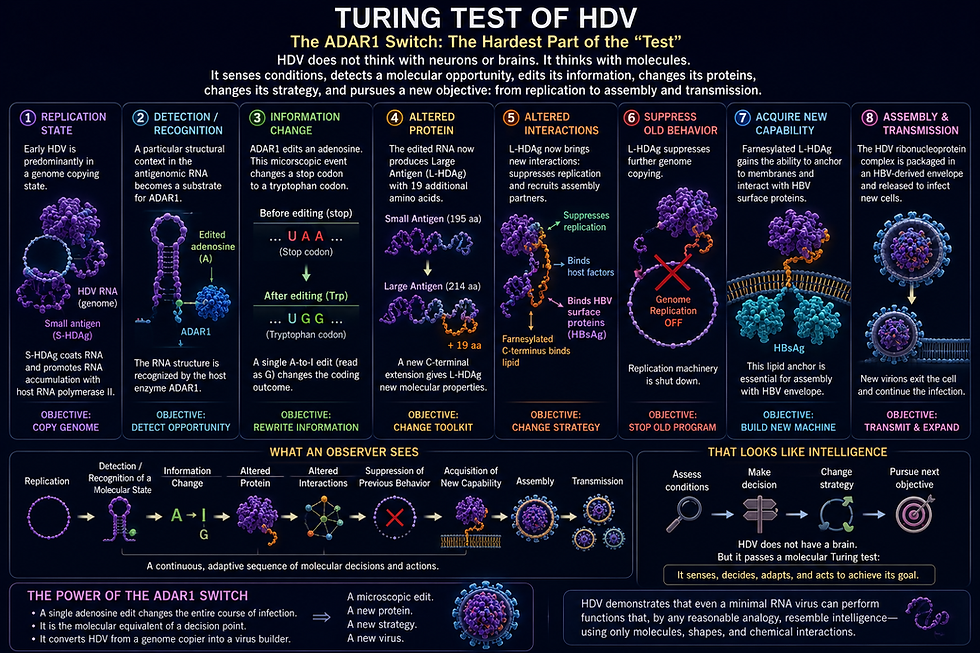
The hypothetical “molecular Turing test”: whether the system being observed is controlled by an intelligent agent or arises entirely from biochemical interactions. We ask whether it can perform intelligence associated operations.
Can it distinguish different environmental states? Hepatitis D virus can. Its behavior depends upon which proteins are available, where the ribonuclear protein complex is located, the structural state of its RNA, the modification state of antigen protein, the availability of hepatitis B virus envelope proteins, and many other molecular conditions.
Can it obtain information from its environment? Yes. Molecular encounters alter the subsequent state of the viral system.
Can it respond differently to different information? Yes. The same viral components participate in different interaction networks depending upon RNA structure, hepatitis D virus antigen modification, localization, and stage of infection.
Can it exploit resources rather than unnecessarily manufacture them? Extremely effectively. Hepatitis D virus uses cell polymerases, transport proteins, editing enzymes, modifying enzymes, membranes and trafficking systems and borrows envelope proteins from hepatitis B virus.
Can it alter its strategy? Its transition from genome replication toward assembly is the strongest example.
Can previous events alter future behavior? Yes. RNA editing and protein modifications create persistent molecular states that influence subsequent interactions.
Can it coordinate multiple processes toward an outcome? Yes. Nuclear transport, RNA genome copying, ribozyme cleavage, hepatitis D virus antigen protein production, editing, producing a lipid connecting link, ribonuclear protein complex assembly, interaction with hepatitis B virus proteins, transport through cell, and produce and release new infectious progeny.
Viewed strictly from the outside, this is remarkably intelligence like behavior.
The Switch Made By Enzyme ADAR1
Of all of the virus' behavior, perhaps the ADAR1 switch most closely shows intellligence. For the details of ADAR1 editing of the hepatitis D virus RNA letter please see the previous post, which describes the entire life cycle of the virus: Smallest Human Virus – Very Dangerous, Very Intelligent

Early hepatitis D virus is predominantly in a genome copying state. Hepatitis D virus small antigen participates in viral RNA accumulation in many different ways. Eventually a particular structural event in the antigenomic RNA becomes a substrate for the ADAR1 enzyme.
After extensive RNA folding behavior, ADAR1 edits an adenosine nucleotide in the virus RNA. This minuscule event eventually changes a code in the amino acid letters that represent "stop producing the protein" to that of representing a "tryptophan" amino acid, allowing production of hepatitis D virus large antigen with 19 additional amino acids.
After this, the entire system behaves differently. Large antigen suppresses genome copying and supports assembly of new virus. Its new sequence permits binding with a lipid molecule that gives it the molecular capability required for productive interaction with hepatitis B virus surface proteins. The hepatitis D virus ribonuclear protein complex can then become packaged within an hepatitis B virus derived envelope.
An observer sees:
Genome copying → detection/recognition of a molecular state → information change → altered protein → altered interactions → suppression of the previous behavior → acquisition of a new capability → assembly → transmission.
That looks like:
Assess conditions → make decision → change strategy → pursue next objective.

Where Hepatitis D Virus Would Pass—And Fail—the Turing-like test
Ask a human and we receive a first-person rationale. “I have enough genomes. I should stop replicating and begin packaging.”
Looking at the virus: RNA structural flexibility and movement changes the ADAR1 recognition event and eventually alters the total direction of the virus activity.
At every individual step, ordinary chemistry might be sufficient. But, when steps are viewed as a complete trajectory, it strongly resembles purposeful behavior.
This is a limitation of the Turing idea
If we define intelligence exclusively by outward behavior. Hepatitis D virus senses, responds, switches states, retains information about previous events, solves problems, uses resources, coordinates actions, adapts its behavior to molecular context, produces an extraordinarily consistent outcome—more infectious hepatitis D virus.
A purely behavioral definition pushes us toward calling this intelligence. But the mechanism consists of thousands of local physical interactions rather than a central thinking entity. This pushes us to say hepatitis D virus isn't intelligent.
The human brain creates a surprising comparison

The Brain and the Virus: An Organizational Parallel
A neuron does not understand thought. A glutamate receptor does not know what a memory means. An ion channel does not understand intention. Yet billions of such locally responding components—each reacting only to voltage, calcium, neurotransmitters, and phosphorylation—somehow combine to produce a human who can say: "I have decided to stand up."
Hepatitis D virus works in the same way at a simpler scale. Its RNA responds to polymerase availability. Its protein responds to RNA structure. Its components respond to cell enzymes and cellular location. No component that we know understands infection, replication, or virion assembly. Yet these local interactions coordinate to produce infectious particles that propagate through the bloodstream.
Both systems follow the same organizational pattern:
local interactions → distributed information processing → feedback loops → state transitions → coordinated global behavior.
The difference is not in the principle but in complexity and scale.
This raises a more productive question than "Does hepatitis D virus think like a brain?" Instead, ask: "Which organizational properties normally associated with intelligence already exist at this molecular level?"
Hepatitis D virus possesses many: molecular recognition, information transfer, state-dependent responses, feedback, molecular memory, context sensitivity, distributed control, competition among alternative states, coordination across time, and adaptive switching.
What it apparently lacks are the higher-order subjective properties of cognition.
This suggests there is not a sharp boundary between chemistry and intelligence, but a hierarchy:
Chemistry → molecular recognition → signaling → feedback → memory → distributed decision-making → adaptive networks → cognition → reflective intelligence
The fundamental logic of what we call intelligence did not originate with nervous systems. Nervous systems merely elaborated informational principles that molecules had been using for billions of years. Rather than asking the vague, impossible to answer, question whether hepatitis D virus possesses a mind——the more revealing question is: "At what level of organization does information-processing behavior become something we are willing to call intelligence?"
Hepatitis D virus sits almost precisely at that boundary.