
The Cerebral Cortex Does Not Generate the Human Mind

Updated: May 28
Perhaps the most widely known scientific hypothesis that scientists and the general public assume is true is that the human brain generates the human mind. But this remains a hypothesis because no scientific theory has been developed to explain how a brain can generate a mind. In fact, much of the evidence gathered over time outright refutes this hypothesis. One example of such evidence comes in the form of defects that have been well studied for many decades.
Hydranencephaly
Hydranencephaly is a birth defect where infants are born with a cerebral cortex filled with cerebrospinal fluid instead of neurons. The image below is a brain scan taken of an infant with Hydranencephaly.[1] The dark areas show cerebral spinal fluid filled sacs where normally the neurons of the .
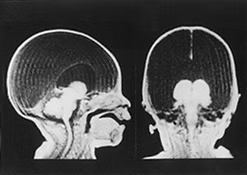
Infants with Hydranencephaly behave similarly to infants born with a normal cortex for the first few months of their lives, then fall behind their peers and largely remain at the intelligence level of infants for the remainder of their lives. These children lack the higher-level neuronal processing that enables advanced levels of human intelligence that appear to require a cerebral cortex. As the most advanced part of the brain, the cortex has long been the primary target of neuroscientific searches for neuronal processes that might be able to generate the human mind. Thus if these children demonstrate behaviors that suggest the presence of a mind, then the cortex can effectively be ruled out as a brain region to generate the mind.
Hydranencephaly newborns immediately demonstrate normal muscle movements like sucking, swallowing, crying, and moving their arms and legs in ways that seem quite normal. Muscle movements are controlled by the cerebellum, the region of the brain that is usually fully formed in these children, explaining how they can control their muscles in the same way as children born with a normal cortex. A few months into life hydranencephaly infants are awake, alert, smile, laugh, feel pain, have emotional responses to objects and people, recognize their parents and other people, have favorite songs, can reach for their favorite toys and play with them, and some can even recognize themselves in a mirror. [2]
Being able to recognize people and toys means these infants can develop memories without a cerebral cortex and have some amount of vision capability without a visual cortex. These infants typically have normally developed eyes with retinas that capture visual information from the external world. This information is sent via synapses to the visual cortex for further processing, but this brain region is missing in these children. Yet these children have some amount of visual awareness, presumably at much lower resolution and with much less vibrant colors given they lack the advanced image processing capabilities provided by the visual cortex. Since they can see without a visual cortex, this is direct evidence that the visual cortex is not required for vision.
Since these infants can recognize family members and favorite toys, the cerebral cortex also does not appear to be required for cognition and memory. The missing cortex also does not appear to be required to process the emotions and moods these infants demonstrate as well. Since these infants demonstrate a wide array of conscious experiences, they collective provide clear and compelling evidence that none of these experiences require the cerebral cortex.
In my book Cellular Mind I suggest that the sensory systems of these infants not only synapse information to the brain, but every synapse also emits information into the electromagnetic field that surrounds and pervades the bodies of multicellular organisms. These infants have at least rudimentary versions of all 5 senses rather than the advanced high resolution vibrant sensory experiences that are produced by the cerebral cortex.
Some of these infants demonstrate self-awareness via the mirror test, which has only been demonstrated by humans, advanced primates, octopuses, and dolphins. Self-awareness requires the awareness that a self exists and a sufficient level of intelligence and memory capability to recognize that the image in the mirror is oneself. This means the cerebral cortex is not required to develop a sense of self, creating yet another mystery for brain-generated mind theory. In Cellular Mind I suggest the mind and the self are full-body collective cellular phenomenon - hence the cerebral cortex is not required for a sense of self.
In another case, a college student had an MRI scan only to find he was missing 90% of his cerebral cortex, a case of partial hydranencephaly. He had a thin 1 mm layer of neurons surrounding his cerebral cortex, while the interior was filled with cerebrospinal fluid. Despite missing more than 90% of the neurons in his cerebral cortex, this student had an IQ of 126, graduated college with an honors degree in math, and had a normal social life. Cases like this are the likely source of the popular culture view that humans only need a small portion of their brain to function normally in society. [3]
Functional mapping of the cerebral cortex has attributed roughly 50% of its neurons to be dedicated to visual processing. The vast majority of the remaining 50% of its neurons have been mapped to the senses of touch, taste, smell, and hearing. There is little unmapped neuronal capacity in the cortex that remains that could possibly generate the mind. It is striking is that problematic evidence from hydranencephaly combined with little-to-no excess capacity after brain mapping has been known for decades, yet the search for mind as a neuronal process in the brain continues to focus primarily on the cerebral cortex. As the most advanced and complex brain region, scientists who firmly believe that the brain generates the mind apparently routinely ignore this evidence or consider it "anomalous" and thus not relevant. The bottom line is that infants with hydranencephaly provide strong and compelling evidence that the human mind is not generated by the cerebral cortex.
Cerebellar Agenesis
The brain scan below is from a 44-year-old man who led a normal life as a white-collar worker despite missing 90% of his cerebellum, a condition called cerebellar agenesis [4]. The dark areas show cerebral spinal fluid-filled sacs instead of neurons that would exist in a normal cerebellum. [5]

The cerebellum controls bodily movements and balance, explaining why these patients have physical impairments while otherwise leading normal lives with normal conscious experiences. This brain defect suggests that the cerebellum is unlikely to be involved in generating the mind. The evidence is clear that the human mind can have conscious experiences of our senses, emotions, memory, and sense of self without a cerebral cortex or a cerebellum. This effectively rules out these two brain regions as candidates to generate the mind.
Smaller Brain Regions
Since 98% of brain neurons are located in the cerebral cortex and cerebellum, the search for a scientific theory of brain-generated mind must therefore focus on the remaining 2% of neurons located in smaller brain structures like the amygdala, hippocampus, thalamus, hypothalamus, basal ganglia, and/or cingulate gyrus. But each of these regions has been extensively studied and mapped to specific functions, leaving little-to-no surplus neuronal processing capacity to generate the human mind.
The Claustrum as the Final Frontier
The claustrum, a thin layer of neurons that connect different regions of the brain, is another brain structure that some neuroscientists believe may generate the mind. The problem in studying this structure is that imaging and conducting experiments on such a thin layer of neurons is quite difficult. There are also relatively few patients with claustrum damage or defects that can shed any light on its functionality. While its functionality remains a mystery, it has been speculated to integrate sensory and cognitive information, to direct attention, control behavior, and/or to generate the mind. The claustrum is perhaps the only remaining candidate brain region that could possibly generate the human mind. Yet that fact that the claustrum contains just 0.05% of the brain's neurons strains credulity to believe that such a miniscule number of neurons could generate the vibrant experiences of our 5 senses, our sense of self, our awareness of the external world and internal sensations within our bodies, and of course our feelings and emotions.
Birth defects can rule out the 98% of neurons in the cerebral cortex and cerebellum as candidate brain regions to generate the human mind. 1.95% of the remaining neurons in well studied and well mapped brain regions can be ruled out as candidate brain regions to generate the mind. This leaves the 0.05% of neurons in the claustrum as the only viable candidate neurons to generate the mind, the final frontier for brain generated mind theory.
[1[ Yuge, T. and Kaga, K., 1998. Brain functions of an infant with hydranencephaly revealed by auditory evoked potentials. International Journal of Pediatric Otorhinolaryngology, 45(1), pp.91-95.
[2] Pereira, C., 2016. Consciousness is quantum computed beyond the limits of the brain: A perspective conceived from cases studied for hydranencephaly. NeuroQuantology, 14(3), pp.613-618.
[3] Lewin, R., 1980. Is Your Brain Really Necessary? Science, 210(4475), pp.1232-1234.
[4] Feng Yu, Qing-jun Jiang, Xi-yan Sun, Rong-wei Zhang, A new case of complete primary cerebellar agenesis: clinical and imaging findings in a living patient, Brain, Volume 138, Issue 6, June 2015, Page e353.
[5] Feuillet, L., Dufour, H. and Pelletier, J., 2007. Brain of a white-collar worker. The Lancet, 370(9583), p.262.


