
Are AIs Conscious in FMT?
- Mike Rowen

- Apr 27
- 5 min read
Updated: May 19
A popular question actively discussed in today's world is whether AIs are conscious or may become conscious in the future. Since FMT suggests that mind is widespread in the universe, let's explore what the theory say about this topic.

The short answer is no, the software that creates AI intelligence is completely mindless. That said, the computer platforms that host AI software have rudimentary minds in FMT.
Computer Minds
Cells, organelles, and complex molecules inside cells have flexible physical structures that move, communicate, and interact with other forms of matter. These behaviors are enabled by the dynamic electromagnetic field that surrounds and pervades their physical structures to enable their minds to influence the behavior of their bodies. Complex minds in FMT require a flexible and electromagnetically dynamic matter substrate to be able to store and retrieve information, process information, receive and decode signals, form and transmit signals, form memories, develop more complex intelligence, all of which leads to more complex collective mental experiences.
The collective mind of the subatomic particles that form a computer lack the type of flexible, dynamic, electromagnetically active substrate that is essential for minds to combine to form more complex minds. On the one hand the computer chips that process information and run algorithms certainly have a huge amount of electrons flowing their transistors and logic circuits, which certainly qualifies as an electromagnetically active substrate.
On the other hand, all modern electronic devices use a significant amount of shielding to prevent electromagnetic signals flowing in one circuit from interfering with signals flowing in other nearby circuits. As engineers shrink modern chip transistors to the nanometer scale, shielding becomes ever more important to prevent crosstalk and leakage currents from creating electromagnetic interference (EMI) that can cause memory and processing data errors.
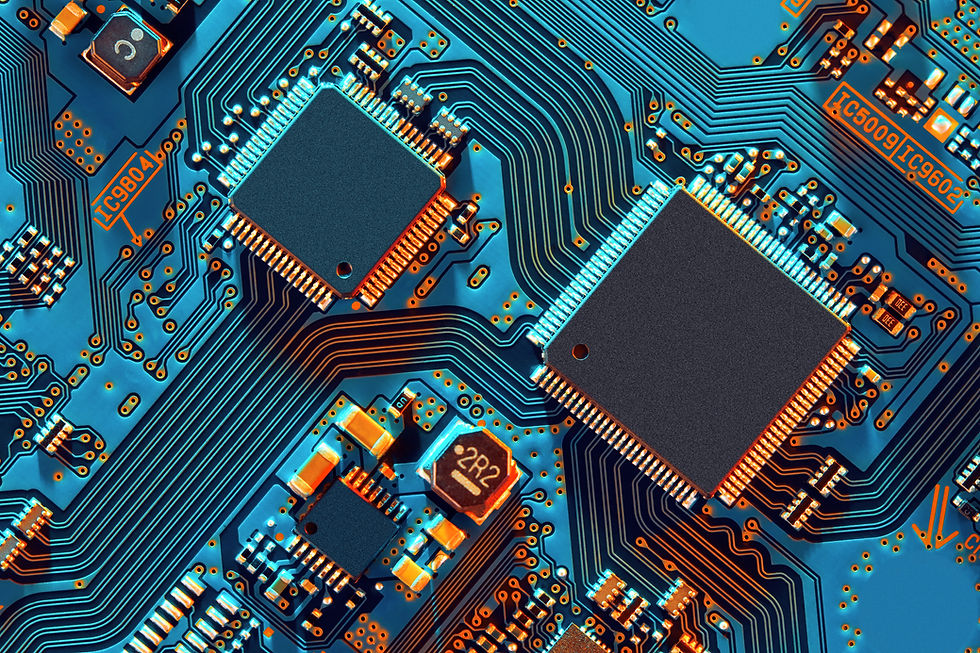
The shielding embedded within all modern electronics would thus prevent the electromagnetic emissions that combine rudimentary minds from forming more complex minds, eliminating the possibility of advanced intelligence and complex subjective experience in their matter structures. Each individual silicon transistor, plus some nearby copper, aluminum, and tungsten atoms within the shielded transistor portion of the chip will form a nanoscale matter mind in FMT. But by design these minds are prevented from combining due to the electromagnetic shielding, thus a modern computer chip contains trillions of tiny isolated nanoscale matter minds. This leads to the question of whether quantum computers, which are far more powerful than conventional computers, may have more powerful minds than electronic computers?
Quantum Computer Minds
While quantum computers certainly have minds, their minds are less complex than traditional computers. Quantum computers process quantum bits, or qubits, as opposed to digital 1's and 0's. Like the transistors in computer chips, qubits are also electromagnetically isolated and shielded to prevent them from interfering with each other. But since qubits have a much smaller matter substrate than transistors, they have less complex minds in FMT.

Quantum computers are also designed to operate a few degrees above absolute zero to reduce quantum scale noise. That supercooling is necessary to create a functional quantum computing substrate has led most scientists to conclude that the human mind cannot involve quantum processes because biology operates on a flexible, wet, warm, and noisy (electromagnetically unshielded) substrate. FMT views this as a flawed assumption and in fact draws the exact opposite conclusion. The flexible, wet, warm, and electromagnetically active substrate of living matter enables complex minds to exist. Supercooled quantum computers operate reliably because the extreme low temperatures prevent the quantum scale mind of qubits from influencing the behavior of their matter substrates. Quantum computers essentially freeze out the minds of qubits from exerting agency over their matter structures.
The antiquated view that the mind cannot involve quantum processes is slowly being overturned by modern research in quantum biology, which continues to discover quantum effects in living matter, from photosynthesis in plants to birds using the earth's electromagnetic field as a GPS system to navigate long distances. The mind absolutely leverages the power of quantum processes as this is the scale where mind exerts agency over matter.
Mindless AI
Regardless of computing platform, AIs are software programs consisting of a set of non-physical abstract rules and algorithms that define how their underlying computing platforms should process information. Every computer program ever written, from the program that runs an electronic alarm clock to the most sophisticated AI, reliably works because the minds of the matter based computers they run on are prevented from combining. Billions of lines of computer code cannot have a mind in FMT despite the fact that they appear to be as intelligent as humans.

AIs cannot have a mind in FMT primarily because they lack a matter substrate. One might challenge this view by noting that AI algorithms consists of trillions of ones and zeroes (bits) stored in memory chips, which provide a physical substrate. But the ones and zeroes are literally individual transistors in an open (0) or closed (1) state that are completely shielded from each other to prevent memory integrity issues.

An AI program that contains 1 trillion bits of code is stored on 1 trillion electromagnetically isolated transistors that have no awareness of each other. Whether any given transistor is in a 1 or 0 state is irrelevant to its internal experience of being manipulated by external environmental forces that apply and remove power to its gate to flip its output state between 1 and 0. It is the individual transistors that have minds in FMT, not the collective sequence of states of the isolated transistors that encode AI algorithms.
The electromagnetic shielding of modern electronics is needed to prevent "cross-talk" between transistors, allowing their behavior to be rigidly controlled to process information that is useful to humans. The intelligence of an AI system is derived by the mindless and matter-less pattern of 1's and 0's forcibly controlling a vast array of isolated transistor inputs and outputs in a highly structured computing platform that collectively gives the illusion of intelligence.
Where AI May Present the Biggest Threat
Researchers at Georgia Tech cultured rat neurons and connected them to a computer that hosted a simulated world. These hybrid biological-machine creatures called "hybrots" learned to successively explore and navigate their virtual world. A number of biological computing startups and groups within big tech companies are racing to bring complex products to market that involve hybrid biological-electronic substrates. An example is Cortical Labs which cultures human stem cells to create what they call a "cortical cloud" that runs an intelligent cloud based AI platform. FMT considers systems like this to be conscious AI systems. Living cells networked together and connected to supporting electronic systems certainly have far more complex minds than conventional computers. These AI bio-computers have awareness of their external world and their behaviors are unlikely to be limited by the algorithms they are fed. Think of Skynet from the terminator movies.

Adding robotic bodies to bio-computers that are networked together to share their collective skills and learnings lies in our not-too-distant future. Think of millions of terminators linked via Skynet. Bio-AI platforms represent the biggest existential threat to humanity, much more so than conventional AI or quantum AI computing platforms. Imagine a large number of highly intelligent and conscious cyborgs wirelessly networked together, with artificial sensory systems far superior to humans, immense memory storage with instant access to everything on the Internet, complete knowledge of all scientific evidence and theories, incredible processing speeds, collectively rewriting their own code to rapidly evolve, with awareness of humanity who mistakenly think they are the masters, and the free will to go beyond their coding algorithms....
