
A Strand of RNA with Only 250 Nucleotides Has a Complex Lifestyle
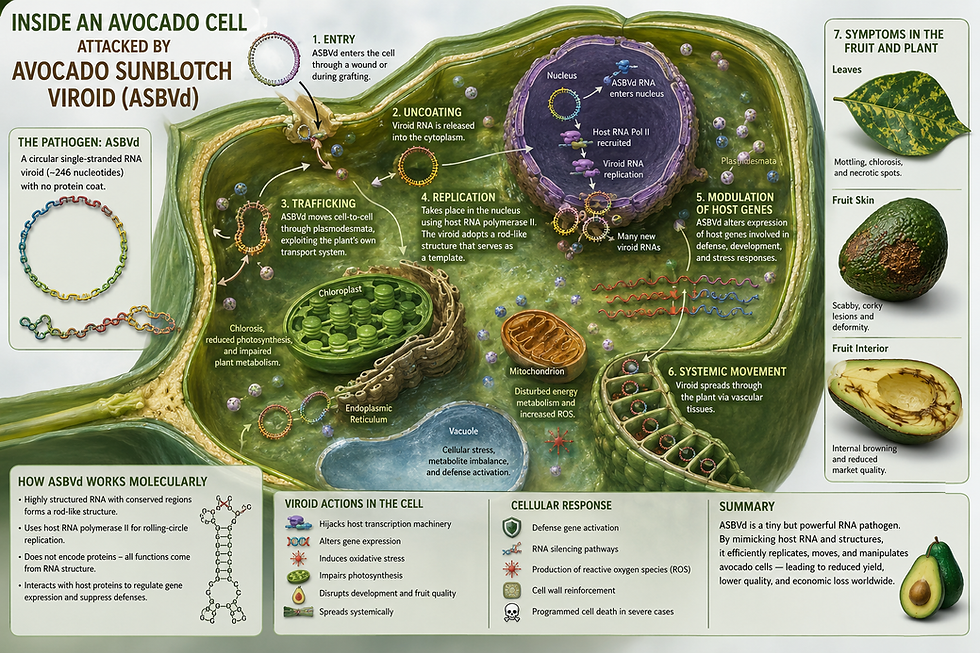
A viroid is smaller than a virus. It is a strand of RNA with 246 to 467 nucleotides in length. It is single-stranded, with extensive self-bonding between bases and forms into a fluctuating rod-like or branched structure. It does not produce proteins, has no capsid or membrane, and hijacks cell enzymes to copy itself with a circular rolling mechanism. Thus far, viroids are only found in plants. Also, they can contain ribozymes, which are RNA regions that are able to accurately cut an exact copy of its genome from a much longer RNA strand.
Among all known pathogens, avocado viroid is one of biology's most astonishing examples of how little RNA can do so much. With only about 246–251 RNA letters, it is one of the smallest creatures that can reproduce itself with the help of a cell. It has no metabolism, and no ribosomes. It is a tiny circular strand of RNA folded into a very complex three-dimensional structure.
Yet avocado virus has a remarkably sophisticated lifestyle that enables it to infect avocado trees, make copies of itself, spread throughout the plant, evade cell defenses, persist for decades, and transmit itself across generations. Its biological complexity is not determined by the number of genes, but by how effectively it can produce RNA molecular structures to exploit the machinery of living cells.
Unlike viruses, which typically produce proteins that manipulate their hosts, it accomplishes every stage of its life cycle using only various RNA shapes as a dynamic molecular machine. The sequence itself is important, but more important is how that sequence folds into stems (regions of RNA folded back on itself), loops at the end of stems, bulges in stems, junctions of multiple stems, and transient shapes that change during the copying process. Every nucleotide participates simultaneously in multiple different roles, as the RNA assumes many different shapes. A single base may contribute, at different moments, to maintaining the global structure, recognizing a cell enzyme, helping to determine a particular fold structure, and influencing the stability of neighboring regions. In this extremely compressed genome, there is virtually no unused information.

Making Copies
Avocado viroids copy themselves within chloroplasts rather than a nucleus, using chloroplast enzymes. The chloroplast of a plant cell, like mitochondria, was a cell billions of years ago that adapted to live in plant cells to produce energy from light for the plant cell to use in exchange for protection. Living in chloroplasts distinguishes avocado viroid from most other viroids, who live in the nucleus. Chloroplasts evolved from ancient cyanobacteria and retain specialized RNA copying machinery and metabolic conditions unlike those of the nucleus. Living in the chloroplast reduces the effect of the many cellular defense systems, which are focused on the nucleus. Avocado viroid originally enters the cell after a plant injury or gardener’s grafting cut. Then it fools the cell’s transport mechanisms to enter the chloroplast.
Avocado viroid persuades the chloroplast enzymes to copy its RNA, by convincing plant enzymes that it resembles a legitimate cellular RNA. It tricks chloroplast enzymes with a unique rod-like structure that forms a 3D shape, mimicking a master key to the cell’s machinery. The viroid’s rod-like structure, also, mimics and intercepts signals between the nucleus and the chloroplast. The host enzyme then synthesizes long RNA transcripts that have multiple copies of the total viroid genome. These long copies are cut by the viroid’s ribozyme region to exactly produce one viroid genome. The two ends are then joined into new circular genomes by hijacked plant enzymes. Somehow, it uses its RNA structure to have copies made, while remaining invisible from the cell’s detection sensors. It fools the cell into thinking it is nothing more than a folded cellular RNA molecule.
Although its genome is tiny, it forms a very large set of structures. This is because the RNA is not static. It continuously moves, flexes, and refolds with changing ionic conditions, temperature, protein interactions, and the various stages involved in making copies. Avocado viroid’s dancing movements continuously sample local shape changes while maintaining an overall rod-like or branched architecture that supports making copies and interactions with the cell.
Avocado viroid RNA hair pin loops form when the single strand of RNA folds back on itself and transiently opens and closes. The transient rapid changes of opening and closing the loop expose different sites for the cell’s proteins to bind, momentarily exposing them and then hiding them. These dynamic shape changes regulate the stages of its life cycle, including making the copy, cutting actions of the ribozyme, and interactions with cell defense systems. The viroid behaves less like a simple molecule and more like a nanoscale molecular machine whose moving parts consist entirely of different RNA actionable shapes.

Cell’s Immune Surveillance
Immune evasion is one of avocado viroid’s remarkable achievements. Plants have sophisticated RNA surveillance systems to recognize foreign nucleic acids. Sensors in the cell cut the viroid into pieces and then use these pieces to attack the viroid RNA. Avacado Viroid has an exceptionally compact and highly internally self-bonded structure. Extensive internal pairing hides vulnerable regions from the cell’s attack enzymes and the cell’s immune sensors. The constant transient folding minimizes exposing to the sensors the types of RNA that is usually attacked. By continuously changing shapes, sites on the viroid that may be recognized by the cell appear only transiently before disappearing again.
Even when the cell’s attack is successful, viroid destruction does not always occur. However, some of the cut pieces of viroid RNA resemble normal plant regulatory RNAs. The cell’s defense mechanism therefore attacks its own molecules. Instead of harming the avocado viroid, it disrupts the plant's own gene network. These damaged cellular molecules then participate in generating plant disease.
Invisibility and Persistence
Avocado viroid is also extraordinarily successful at long-term persistence. Many infected avocado trees remain alive and productive for years despite continual infection. Complete elimination of the viroid rarely occurs. Instead, the plant and the viroid reach a dynamic equilibrium in which replication, degradation, and immune responses balance one another, a highly evolved strategy to be invisible. If the viroid immediately kills the cell, it limits its own opportunities for transmission. If the viroid can maintain a chronic, low-level infection, it can enjoy decades of successful life in the cell including making many copies and then dispersal.
Movement throughout the plant represents another remarkable accomplishment. Unlike animals, plants possess rigid cell walls that greatly restrict intracellular movement. Avocado viroid overcomes this obstacle by exploiting the microscopic channels connecting neighboring cells. Specific RNA structures recruit the cell’s proteins that facilitate movement through these narrow passages. Then the viroid spreads systemically to distant tissues, eventually colonizing leaves, stems, flowers, roots, and developing seeds. Every stage of this journey depends entirely upon host transport systems manipulated through RNA architecture rather than protein actions.
Transmission further illustrates the elegance of its long term strategy. It spreads when gardener’s graft roots and by contaminated pruning tools. It also spreads by vegetative propagation, pollen, and seeds. Particularly remarkable is its efficient transmission from one generation to the next. Seeds produced by infected trees carry the viroid into the next generation, allowing it to bypass many environmental hazards that free-living pathogens encounter. This intimate association with plant reproduction enables the viroid to persist over evolutionary timescales alongside its plant’s lineage.
Information In Changing Shapes
A deep lesson from avocado viroid is that biological information extends far beyond nucleotide sequences. The informational content of the viroid resides in its three-dimensional architecture, its folding pathways, its dynamic transient shape changes, and the timing of those changes during interactions with host molecules. Every bend, stem, bulge, loop, and catalytic junction represents another layer of encoded biological information. This is the language of RNA shapes that began with the creation of Adenosine.
Avocado viroid challenges assumptions about the minimum requirements for life-like behavior. It replicates, evolves, adapts, persists, exploits cellular resources, evades host defenses, spreads through tissues, colonizes new hosts, and survives across generations. All of this emerges from fewer than 250 RNA nucleotides arranged into an exquisitely folded molecular architecture. It demonstrates the power of molecular design. It shows that in biology, complexity often resides not in the quantity of molecules but in the elegance with which they are organized and the dynamic conversations they conduct with the living cell.


