
Resolving the Combination Problem with Existing Science
Michael Rowen
January 25, 2026
Introduction
Most scientists and philosophers assume the human mind is generated by the brain, yet despite centuries of brain research no theory has been developed to explain how neuronal processes in our brains can produce the vibrant conscious experiences of our minds. Several frameworks attempt to explain various aspects of conscious experience, but they always include an identity claim such as “this pattern of neuronal activity produces conscious experience X." But asserting an identity relationship between brain states and conscious states does not causally explain how a pattern of neuronal activity creates conscious experiences using the laws, principles, and theories of science. This is widely recognized as the “Hard Problem of Consciousness”, a term coined by philosopher David Chalmers in 1995.
One way to illustrate the hard problem is to consider the experience of the sweet taste of chocolate, the pungent smell of a skunk, excitement, anxiety, love, and pain. These experiences are all “qualitative” in nature, have no units of measure, and cannot be reduced to the “quantitative” variables and equations of science. The conscious experiences of our minds are “mental” phenomena whereas science describes “physical” phenomena. We “experience” the world from an “internal, 1st person, and subjective” point of view that is completely private to each of us. Meanwhile physical science describes the “behavior” of objects in the universe from an “external, 3rd person, and objective” point of view that is publicly observable and quantitatively measurable with scientific instrumentation. Quantitative vs. qualitative, objective vs. subjective, 1st person vs. 3rd person, internal vs. external, experience vs. behavior, and physical vs. mental. These characteristics are complete opposites of one another, which explains why the “quantitative, 3rd person, objective, physical, external behavior” theories of science have been unable to explain the “qualitative, 1st person, subjective, internal, mental experiences” of the human mind. The hard problem remains unsolved as one of the most intractable problems in the entirety of science.
Given the difficulty in resolving the hard problem and lack of progress in developing a scientific theory explaining how brains generate minds, it is time to consider the possibility that our minds may not be generated by our brains, which involve viewpoints beyond the metaphysical views of materialism which the brain generated mind hypothesis is rooted in. Several metaphysical positions avoid the hard problem but face their other unique conceptual problems. Dualism posits that the human mind is a non-physical property or substance that interacts with physical matter, which leads to the “mind-body problem” that questions how a non-physical mind can interact with a physical body. Idealism posits that mind is more fundamental than matter which essentially flips the hard problem on its head, leading to a “hard problem of matter”. Panpsychism posits that mind is embedded in matter at every scale of the universe and combines to form more complex minds in more complex forms of matter, leading to the mind “combination problem” which questions how rudimentary forms of mind can combine to form complex forms of minds in atoms, molecules, cells, and ultimately humans. The combination problem is the only one of these alternatives that appears to be within the scope of existing science, hence is the subject of this paper.
The combination problem traces back to 1890 when philosopher William James challenged panpsychism by arguing that individual conscious experiences cannot be combined to form a single unified conscious experience. James’ challenge has withstood the test of time as many solutions have been proposed but none have received widespread support from philosophers and scientists. Most of these solutions start by analyzing the properties of complex minds and use reductionist logic to deduce the mental properties of rudimentary forms of mind while speculating on how they may combine. The present solution takes the opposite approach by starting with the hypothesis that mind is fundamental and illustrating how rudimentary forms of mind can combine using existing scientific theories and principles. This bottom-up approach requires one assumption - that existing scientific laws that apply to all forms and scales of matter would apply equally to all forms and scales of mind. In other words, if mind exists at the quantum scale, then the laws of quantum physics would apply equally to quantum scale matter and quantum scale mind. Likewise, as matter is molded into more complex forms by the forces of nature, mind would also be molded into more complex forms by the same forces of nature. This discussion will show that this singular assumption - that matter and mind should be treated identically from a scientific standpoint - is sufficient to resolve the mind combination problem.
Before we dive into the proposed solution, one point needs to be addressed. Since there is no consensus definition for two key terms used in the introduction - consciousness and mind - it is important to define these terms as they will be used in the following discussion. The author recognizes the significant nuance and subtlety surrounding these terms as they are used in the sophisticated body of work produced by the philosophy of mind community. The proposed solution is independent of these complexities so to keep the discussion simple, mind and consciousness will be used interchangeably to refer to “the phenomenon that is experiencing your life”.
Matter Combination Theory
The most fundamental constituents of matter and energy in the universe are described by the "Standard Model of Elementary Particles."
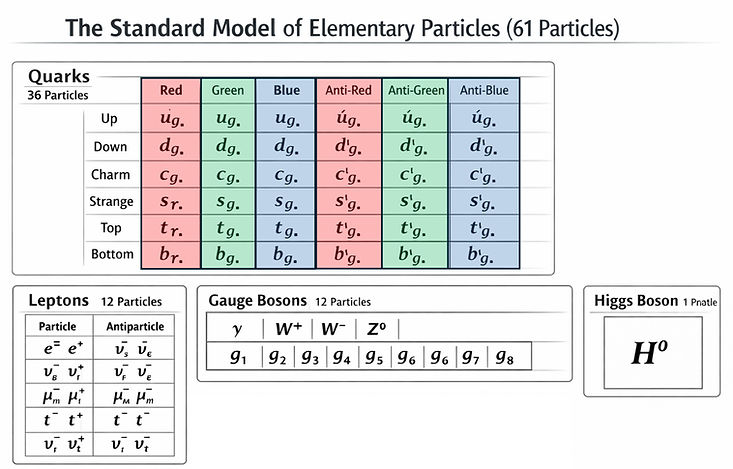
The standard model currently contains 61 elementary particles that have been directly or indirectly detected in laboratories and particle colliders. The vast majority of these particles can only exist for a tiny fraction of a second before decaying or combining into more stable forms of matter and/or energy. This allows our discussion to focus on the subset of elementary particles that form stable matter, specifically up quarks, down quarks, gluons, electrons and photons.
The most fundamental matter interaction in the universe occurs when the gluons of the strong nuclear force combine one red color charge quark, one green color charge quark, and one blue color charge quark to form a neutral white color charge proton or neutron, the subatomic particles that form atoms.* Whether three quarks combine to form a proton or neutron depends on the mix of up and down quarks being combined. The main takeaway here is that the strong nuclear force combines 3 elementary particles to produce the protons and neutrons that form the nucleus of atoms. This is the smallest matter combination event known to science.
During this matter combination event, all known properties of the particles are conserved, meaning the mass/energy**, spin, charge, and color charge of the incoming quarks and gluons are combined, and the result will match the properties of the resulting proton or neutron. Each property being combined has a unique conservation law associated with it, specifically the conservation of mass/energy, conservation of spin, conservation of charge, and conservation of color charge. That the properties of quarks and gluons are universally combined and conserved in strong nuclear force interactions is a foundational principle in quantum physics.
All the forces of nature behave similarly, combining matter into more complex forms while conserving the properties of the constituent parts in the combined matter structure. The strong nuclear force forms subatomic particles, the electromagnetic force forms lighter weight atoms and molecules, the weak nuclear force forms heavier atoms, and gravity forms moons, planets, stars, black holes, and galaxies. The forces of nature universally combine and conserve every known property of matter, in every type of matter interaction, at every scale of the universe. This is true whether three quarks combine to form a subatomic particle or whether two galaxies collide to form a larger galaxy. It is now time to bring mind into this combination discussion via two thought experiments.
Thought Experiment #1: Mind as a Property of Quarks
Consider a thought experiment where tomorrow morning scientists announce a discovery that quarks have a 5th fundamental property. Logic dictates that this 5th property would also be combined and conserved by the strong nuclear force along with the 4 previously known properties of quarks when forging protons and neutrons. The scientists would no doubt propose a new universal conservation law associated with this new property since everything in the known universe is subject to conservation laws.
Now imagine this newly discovered property somehow relates to mind existing at the quantum scale, let's call it the "mind property" of quarks. This new mind property would naturally be combined by the strong nuclear force and conserved by the new “conservation of mind” law. The resulting subatomic particle would have the combined mass/energy, charge, spin, color charge, and mind of its constituent quarks and gluons.
Moving up to the atomic scale, the electromagnetic force replaces the strong nuclear force as the primary force driving matter combination events, where photons replace gluons as the carriers of the fundamental force of nature facilitating the combination. Various combinations of subatomic particles are electromagnetically combined to form the 100+ atoms of the periodic table. Atoms are literally forged and held together by the electromagnetic attraction between their constituent electrons and protons, which attract each other and stick together like magnets on your refrigerator. The mass/energy, charge, spin, and mind properties of the subatomic particles would be combined and conserved as the electromagnetic force combines them to forge atoms with atomic scale minds.
Moving up to the molecular scale, the 100+ atoms of the periodic table electromagnetically combine in various ways to form hundreds of millions of molecules. Every molecule is literally held together by the electromagnetic attraction between the protons and electrons in their constituent atoms. The mass/energy, charge, spin, and mind property of atoms would be combined and conserved by the electromagnetic force when forming molecules with molecular scale minds.
The same logic holds as we move up to the cellular scale. Every cell is literally held together by the electromagnetic attraction between protons and electrons in the molecules that form cell membranes and internal cell structures. The mass/energy, charge, spin, and mind properties of subcellular molecules would be combined and conserved by the electromagnetic force when forming cells with cellular scale minds. Finally, multicellular organisms are held together by the electromagnetic attraction between the protons and the electrons in the atoms and molecules that form the membranes of adjacent cells. The mass/energy, charge, spin, and mind properties of cells would be combined and conserved by the electromagnetic force when forming the more complex bodies and minds of multicellular organisms, including humans.
This thought experiment assumed the mind property of matter only exists in quarks. This was done for simplicity purposes as there are no conceptual nor technical reasons why the mind property could not exist in other elementary particles. The thought experiment resolved the combination problem using the simple assumption that scientific laws should apply equally to a hypothetical mind property of matter as they do to all other properties of matter. The author notes this solution includes an implicit and possibly substantive assumption: that mind as a property of matter would behave as an additive, conserved quantity in a similar way that mass, charge, spin, and color charge are additive and conserved. Critics may reasonably object that subjective experience does not obviously possess this additive structure as it is far from obvious what it would mean to 'sum' two units of mind property. This is a valid objection that requires taking the position that the fundamental forces of nature and universal conservation laws of science that apply to every other known property of matter would not apply to a mind property of matter, effectively placing mind beyond scientific explanation.
Thought Experiment #2: Mind as an Elementary Particle
Physicists have been speculating on the possible existence of new particles to explain unexplained phenomena for more than a century since quantum theory was initially formulated in the 1920s. Scientists make predictions based on the assumed properties of hypothetical particles and conduct experiments to test their predictions to confirm or refute the particle’s existence. The most recently discovered particle is the Higgs Boson which was hypothesized in 1964 and experimentally confirmed in 2012, after which it was added to the Standard Model. The Standard Model, and quantum physics more broadly, remain incomplete as physicists continue to search for new particles to explain mysteries such as gravity, dark energy, dark matter, the matter-antimatter imbalance, supersymmetry, the hierarchy problem, universe inflation, and other unexplained phenomena. The hard problem of consciousness suggests that mind is at least as mysterious as these other unexplained phenomena, so let’s consider a second thought experiment where tomorrow scientists announce the discovery of a new “mind particle" that provides evidence of mind operating at the quantum scale.
Each of the 61 elementary particles in the Standard Model has a quantum field associated with it, a field that is believed to span the entire universe. The newly discovered mind particle would thus also have a universal “mind field” associated with it. Let’s assume the mind particle is a boson which would enable it to behave more like a force carrier than as a building block of matter. In essence, the mind boson would be the carrier of a 5th force of nature, a “mind force.” Many scientists have speculated on the possible existence of a 5th force of nature to explain a variety of mysteries. They typically assume this hypothetical 5th force operates at energies below the level that is detectable by modern scientific instruments, providing an explanation for why the 5th force does not create anomalies in atomic spectroscopy and particle accelerators. We will make the same assumption that the mind boson operates below the level detectable by existing scientific instruments, hence new technology needed to be developed before the mind boson could be discovered.
It is useful to consider the behaviors of photons, the carrier of the electromagnetic force, to shed light on the likely behaviors of mind bosons. Because bosons are not subject to the Pauli exclusion principle, multiple bosons can occupy the same quantum state, and because boson fields obey linear superposition, their combined amplitudes seamlessly add to produce a higher-power, unified field that surrounds the source of the bosons. This means that electromagnetic fields generated by multiple particles in proximity will seamlessly combine to form a single integrated and unified electromagnetic field that surrounds the particles. Positively charged protons and negatively charged electrons naturally attract each other, generating tiny electromagnetic fields between them that are facilitated and sustained by photon exchange. When atoms, molecules, and cells combine to form a more complex matter structure, these tiny electromagnetic fields seamlessly combine to form a single, higher power, unified, and integrated electromagnetic field that surrounds and pervades the matter structure.
For simplicity purposes, assume the mind boson is massless, like the photon. This is an assumption of convenience rather than a derived necessity — nothing in principle rules out a mind boson with mass, though a massless boson more cleanly parallels the photon's role in combining electromagnetic fields. Mind bosons would thus similarly combine their energies to form a single, higher power, unified, and integrated mind field that surrounds and pervades every combined matter structure from subatomic particles to humans. Mind as a massless boson would therefore not face a combination problem, provided that the laws and principles of science apply equally to the fundamental constituents of matter and mind.
As with the first thought experiment, there are no conceptual nor technical reasons that prevent the mind particle from being treated as a fermion or gauge boson in this thought experiment. The massless boson was chosen because modeling the mind particle’s behavior after the photon provided a crisper and more coherent analogy.
The Mind Division Problem
Both thought experiments illustrate how matter and mind can combine from elementary particles to cells. Beginning at cellular scale, the combination problem morphs into a "Mind Division Problem" because growth at the cellular scale is primarily driven by cell division as opposed to cell combination. Single cell organisms replicate all of their internal physical structures inside their cell membranes, after which their membranes fold down the middle to split the duplicated internal structures into two separate cells that move away from each and live independent lives with independent minds. Since mind is embedded in the subatomic particles of the divided cells in both thought experiments, the dividing cells would retain their single, integrated and unified mind throughout the cell division process, and would only have functionally independent minds once their electromagnetic fields (or mind fields) no longer meaningfully overlap as the organisms separate.
In multicellular life, the combination problem applies exclusively to egg fertilization. Sperm and egg cells combine their entire physical structures during fertilization, a well-documented scientific fact. As a sperm approaches and enters an egg cell, their electromagnetic fields will naturally combine to produce a single, unified and integrated fertilized-egg electromagnetic field — a straightforward consequence of classical electromagnetism. If mind is either a property or a field of the kind described above, it would combine in the same way, though this remains the paper's hypothesis rather than an independently verified fact. After fertilization occurs, all subsequent growth is driven by cell division as opposed to cell combination. Unlike single-cell life, the dividing cells in multicellular organisms remain in sufficient proximity that their electromagnetic fields continue to substantially overlap throughout development, rather than separating into independent, non-interacting fields. Electromagnetic field strength falls off continuously with distance rather than having a sharp division point, and since the membranes of cells in multicellular organisms remain in physical contact with their neighboring cells, their electromagnetic fields remain unified.
The physical proximity and continuous bioelectric signaling between cells in developing multicellular organisms are consistent with the hypothesis that the boson fields (i.e. electromagnetic and/or mind field) generated by each cell will remain functionally unified throughout development. This means that the collective mind of the cells in a human fetus will remain inside a single, expanding, unified, and integrated boson field that surrounds and pervades every human throughout development, birth, and life of the individual. This provides an explanation for both the unity of our human conscious experience and for our sense of self that persists over time, two phenomena that remain deep mysteries that are hotly debated in the philosophy of mind community.
Possible Evidence That Minds Combine
There is no direct evidence that minds can electromagnetically combine, but there is indirect evidence at the scale of the human brain. A procedure for treating epilepsy involves severing the nerve fibers that connect the two hemispheres of a patient’s brain, which greatly reduces the severity of seizures by preventing them from electromagnetically oscillating between brain hemispheres. Neuroscientists have been studying these “split-brain” patients since 1962 when it was discovered that each hemisphere acts as if it has a separate mind. The left hemisphere controls and receives sensory input from the right side of the body while the right hemisphere controls and receives sensory input from the left side of the body. This is known as the contralateral organization of the brain and body, an organization structure that has allowed scientists to perform isolated hemispheric testing on these split-brain patients.
Experiments on split-brain patients involve presenting isolated sensory stimuli to one hemisphere and soliciting isolated responses to questions from one or the other hemisphere. Split-brain patients give different answers based on whether the isolated stimuli and question are presented to the same hemisphere or opposite hemispheres. Researchers have even “interviewed” each hemisphere of split-brain patients and found they hold differing views on subjects ranging from career goals to a belief in God, evidence consistent with the hypothesis that each hemisphere may host an independent mind. This view fits with a large body of brain research on patients with normal brains where each hemisphere has been found to have a unique learning style, operates with its own working memory, is responsible for different tasks, and contributes unique aspects to a person’s blended personality.
When the nerve bundles connecting the hemispheres are intact, high bandwidth sensory information is shared across the hemispheres electromagnetically via synapses, resulting in the single unified mind that we all experience in our daily lives. But when these nerve bundles are severed, sensory information is no longer shared between the hemispheres via high bandwidth nerve fibers, resulting in each hemisphere experiencing the world exclusively through its half of the body’s sensory systems. The hemisphere thus responds to isolated queries based on the isolated information it received, causing many scientists and philosophers to speculate on the possibility that each hemisphere may have a separate mind. While this is not proof that minds can electromagnetically combine at the scale of human brain hemispheres, it is consistent with the hypotheses offered in both solutions to the combination problem.
Conclusion
The solutions presented do not claim to prove that mind is fundamental, nor do they seek to explain how minds can have subjective experiences. They only seek to illustrate that if mind were one day found to be a fundamental property or an elementary particle, there would be no combination problem preventing individual minds from combining into more complex minds as matter scales from elementary particles to humans. William James' challenge was that rudimentary mental states cannot combine to form more complex mental states, a view the author agrees with. The solutions argue that whatever phenomenon “creates the capacity” for matter to have mental states is what combines, not the individual mental states of more rudimentary forms of matter.
If mind is fundamental and subject to the same scientific laws and principles that matter is subject to, then minds can progressively combine to form more complex minds using the same principles that combine matter from elementary particles to subatomic particles, to atoms, to molecules, to cells, to humans. The foundational principles of the universal conservation laws and the combinatorial power of the forces of nature underpin the entirety of physics at every scale of the universe. Extending these foundational principles to include mind resolves the combination problem and removes the principal objection to panpsychism.
In closing it is worth pointing out that the proposed solutions can be viewed as metaphysically agnostic, consistent with all major metaphysical positions:
-
Materialism: Treating mind as an undiscovered property elementary matter is equally as consistent with materialism as treating mind as an undiscovered property of neural activity in brains. Likewise, treating mind as an undiscovered particle is like treating dark matter as an undiscovered particle, both are consistent with materialism.
-
Idealism: The discussion left open the possibility that mind is more fundamental than matter below the Planck scale, where a universal mind could potentially exist in the quantum vacuum given its ethereal and energetic properties.
-
Dualism: Thought experiment #1 treated mind as a property (consistent with property dualism) and thought experiment #2 treated mind as an elementary particle (consistent with substance dualism).
* Quarks and gluons do not literally have colors as we know them at the human scale. Color charge is a property of quarks discovered in the 1960s which behaves similarly to electric charge but comes in three charge types (red, green, and blue) instead of two types (positive and negative for electric charge). This strange charge-like property was called "Color Charge" as an analogy to the human scale colors red, green, and blue which combine to form a neutral white color. Color charge can be ignored for matter structure larger than quarks, which only involve neutral white color charged matter interacting with other neutral white color charged matter resulting in more neutral white color charged matter.
** Mass and energy are interchangeable properties per Einstein’s E= mc2 equation, thus are treated as a single property for purposes of this discussion.